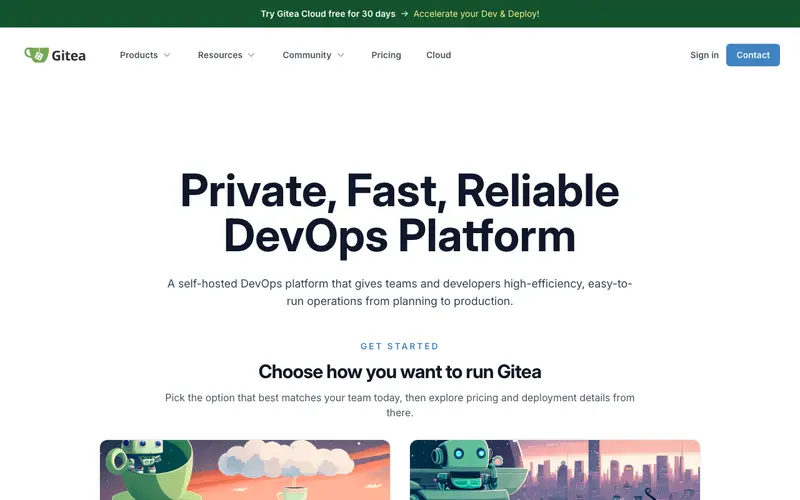
Gitea is a lightweight, self-hosted Git service written in Go, developed by a passionate open-source community as a fork of Gogs. Its core feature is to provide a Git code hosting solution similar to GitHub or GitLab, allowing users to host their own repositories, manage issues, pull requests, and wikis. It's primarily designed for small development teams, individual developers, and organizations looking for a private, resource-efficient Git server that they can fully control. Developers typically interact with Gitea when pushing code, reviewing changes, tracking bugs, or collaborating on software projects, triggered by the need for a local or private version control system. Gitea supports standard Git protocols (HTTP/HTTPS, SSH) and integrates with various CI/CD tools, external authentication sources like LDAP/OAuth2, and package managers, deployable on Linux, macOS, and Windows.
Editorial check
How this page is checked
Source trail
gitea.io
External links are separated from Surfaced commentary.
Reader safety
Context before clicks
Product links and external services are not presented as guarantees.
Monetization
No affiliate flag
Ads and commerce links are kept distinct from editorial text.
Surfaced take
Why It’s Useful
Gitea serves as an excellent open-source alternative to cloud-based Git platforms like GitHub or GitLab, offering comparable features with significantly lower resource consumption and complete data ownership. For the indie game developer, Gitea provides a cost-effective and private way to manage game source code and assets, ensuring all project files are kept in-house. For the small startup, it offers a secure and customizable internal Git server without the overhead or complexity of larger solutions like self-hosted GitLab, which can be resource-intensive. Gitea is entirely free and open-source, maintained by its community. A valuable feature often discovered later is its integrated CI/CD system, 'Gitea Actions' (or Drone CI integration), which allows for automated testing and deployment directly within the platform. Its relative obscurity compared to GitHub is due to the convenience of hosted services and the perceived effort of self-hosting, even though Gitea makes it remarkably easy. The project has a very active development community, frequent releases, and a growing ecosystem of integrations and plugins.






Enjoyed this? Get five picks like this every morning.
Free daily newsletter — zero spam, unsubscribe anytime.