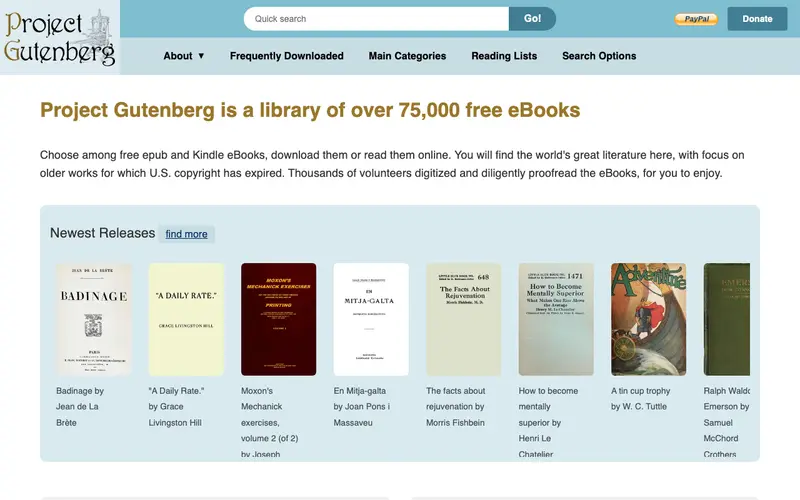
Project Gutenberg is an online library of free eBooks, spearheaded by Michael S. Hart in 1971 and maintained by volunteers. Its core feature is providing free access to digitized cultural works for which U.S. copyright has expired, primarily older literary works. It was primarily built for anyone seeking to read classic literature, academic texts, or historical documents without cost, making knowledge universally accessible. Users typically visit Project Gutenberg when looking for public domain books to read, study, or use for educational purposes, bypassing paywalls and subscriptions. The website is accessible from any web browser on any device, and books can be downloaded in various formats including EPUB, Kindle, HTML, and plain text.
Editorial check
How this page is checked
Source trail
gutenberg.org
External links are separated from Surfaced commentary.
Reader safety
Context before clicks
Product links and external services are not presented as guarantees.
Monetization
No affiliate flag
Ads and commerce links are kept distinct from editorial text.
Surfaced take
Why It’s Useful
While services like Amazon Kindle offer millions of books, Project Gutenberg provides a vast, completely free archive of foundational literature without DRM restrictions, making it invaluable for education and research. For the student studying Victorian literature, it offers immediate access to hundreds of texts without needing to purchase expensive editions. For the casual reader wanting to explore classics, it's a treasure trove of works by authors like Shakespeare, Austen, and Twain, all available at no cost. Project Gutenberg is entirely free and run by volunteers; there are no paid tiers or subscriptions. A powerful but often overlooked feature is its extensive collection of audiobooks and works in various languages beyond English. Its simple, retro interface and focus on older works mean it lacks the modern features and new releases of commercial platforms, leading to less mainstream appeal. It is continuously updated by a dedicated global volunteer community, ensuring new public domain works are regularly digitized and added.





Enjoyed this? Get five picks like this every morning.
Free daily newsletter — zero spam, unsubscribe anytime.