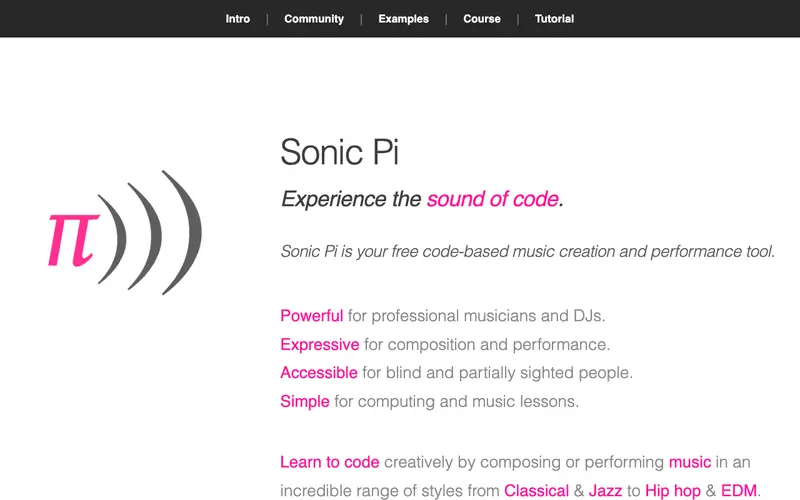
Sonic Pi is a free live coding music synthesis environment, originally developed by Sam Aaron at the University of Cambridge. Its core feature allows users to create and perform music using code, blending programming with artistic expression in real-time. It was built primarily for computer science educators, musicians, DJs, and anyone interested in exploring the creative intersection of code and sound. Users typically open Sonic Pi, write lines of Ruby-based code to define melodies, rhythms, and soundscapes, and then execute the code live to hear the music instantly. It functions as a standalone desktop application, available for macOS, Windows, Linux, and Raspberry Pi.
Editorial check
How this page is checked
Source trail
sonic-pi.net
External links are separated from Surfaced commentary.
Reader safety
Context before clicks
Product links and external services are not presented as guarantees.
Monetization
No affiliate flag
Ads and commerce links are kept distinct from editorial text.
Surfaced take
Why It’s Useful
Sonic Pi provides a unique entry point into music creation, offering a structured yet highly creative alternative to traditional DAWs or physical instruments, by leveraging programming logic. For the aspiring coder interested in creative applications, it makes learning programming concepts like loops and conditionals immediately audible and engaging. For the experimental musician or DJ, it offers a powerful tool for generating generative music, creating dynamic live sets, or even composing entire pieces algorithmically. Sonic Pi is completely free and open-source, fostering a vibrant community. A less obvious but powerful feature is its ability to interact with MIDI devices and OSC (Open Sound Control) messages, allowing it to control external hardware or be controlled by other applications. Its niche appeal to coders and its non-traditional approach to music-making means it hasn't broken into mainstream music production, despite its profound educational and creative potential. It boasts an active community forum, extensive tutorials, and regular updates from its developer.
In everyday life
When you’d actually reach for this
You might use it to create some background music for a casual video you're editing for friends. It's also a fun way to experiment with soundscapes while you're procrastinating on that pile of articles you meant to read.







Enjoyed this? Get five picks like this every morning.
Free daily newsletter — zero spam, unsubscribe anytime.