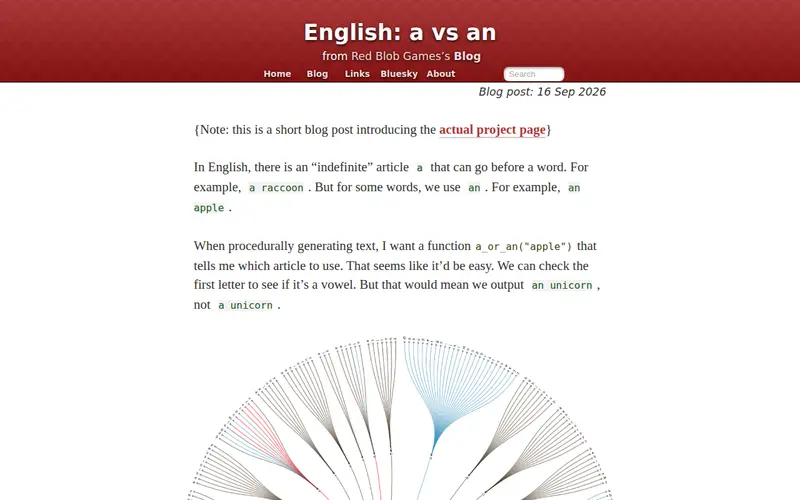
This article delves into the often-overlooked complexities of using 'a' versus 'an' in English. It goes beyond the simple vowel rule to explore nuances like silent letters, foreign word pronunciations, and even specific acronyms. Written by Amit Patel, known for his insightful explanations of complex topics, it aims to provide a comprehensive understanding for writers and language learners alike. The piece offers clear examples and detailed reasoning for each scenario, making it a valuable reference for anyone striving for linguistic precision.
Editorial check
How this page is checked
Source trail
redblobgames.com
External links are separated from Surfaced commentary.
Reader safety
Context before clicks
Product links and external services are not presented as guarantees.
Monetization
No affiliate flag
Ads and commerce links are kept distinct from editorial text.
Surfaced take
Why It’s Useful
While many might assume the 'a' vs. 'an' rule is straightforward, this resource unpacks the exceptions and edge cases that trip up even native speakers. It’s a fantastic example of deep-diving into a seemingly simple grammar point, making it exceptionally useful for writers who need to ensure accuracy and elegance in their prose. Power users of this tool are likely editors, copywriters, and academics who value impeccable grammar. It’s superior to generic grammar checkers because it provides the underlying logic, not just a correction, allowing for genuine learning and application in diverse contexts.
In everyday life
When you’d actually reach for this
You're drafting an email to a client and you're stuck on whether to say 'a historical document' or 'an historical document.' You quickly look this up to confirm the accepted rule, ensuring your professional communication is precise and error-free.







Enjoyed this? Get five picks like this every morning.
Free daily newsletter — zero spam, unsubscribe anytime.