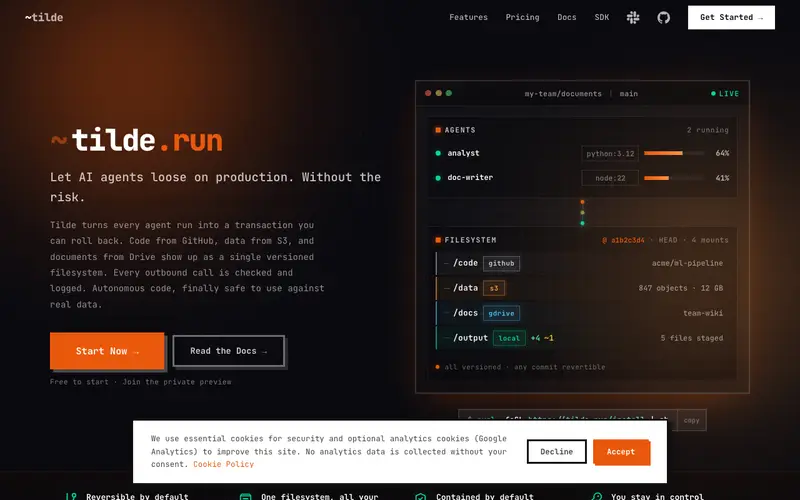
Tilde.run offers a unique sandbox environment for running agent-based code. It provides a transactional, versioned filesystem that allows developers to experiment with code and observe its effects without permanent changes. The system tracks all modifications, enabling users to revert to previous states or fork entire experiments. This is particularly useful for testing complex algorithms, simulating distributed systems, or developing and debugging agents that interact with a simulated environment. A developer could, for example, run a bot designed to trade on a simulated stock market, test different trading strategies, and then easily roll back to a prior state if a strategy proves detrimental, all within a safe, isolated environment.
Editorial check
How this page is checked
Source trail
tilde.run
External links are separated from Surfaced commentary.
Reader safety
Context before clicks
Product links and external services are not presented as guarantees.
Monetization
No affiliate flag
Ads and commerce links are kept distinct from editorial text.
Surfaced take
Why It’s Useful
Tilde.run is a gem for anyone needing a reliable and reproducible environment for experimentation, especially in agent-based development. Its transactional filesystem is a significant differentiator, offering a level of control and safety that many standard development environments lack. This feature means you can make radical changes, test risky hypotheses, and always have a clean slate to return to, fostering bolder experimentation. For those working with AI agents, simulations, or any process involving iterative modification and observation, Tilde.run provides a powerful, yet accessible, platform. It's especially valuable for individuals who appreciate meticulous state management and want to avoid the mess of manual backups and rollbacks. The ability to easily share and reproduce specific states of an experiment is also a hidden benefit for collaborative projects.
In everyday life
When you’d actually reach for this
You're trying out a new recipe for your weekly meal prep and want to see if a minor ingredient swap affects the outcome without ruining your current batch. You're also experimenting with a new budgeting strategy for your household expenses and need a safe space to test out different allocation methods.




Enjoyed this? Get five picks like this every morning.
Free daily newsletter — zero spam, unsubscribe anytime.