Photo via Pexels
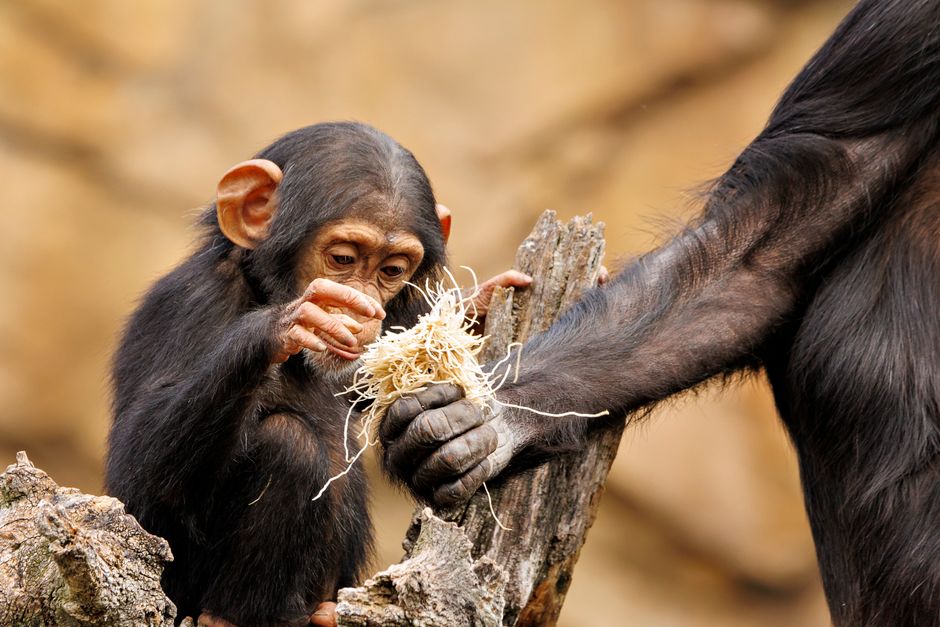
A groundbreaking study published in *Science* in 2017 demonstrated that chimpanzees exhibit spontaneous prosocial helping behavior towards others, even without any expectation of reward. Researchers from Kyoto University, led by Hirayasu Endo, observed that when a chimp struggled to retrieve a tool from a hole, another chimp would readily offer assistance by handing over a suitable tool, a behavior that occurred without any prior social bonding or reciprocal exchange. This finding significantly pushes back the perceived evolutionary timeline for complex altruistic behaviors, suggesting that the roots of helping others without direct personal gain may be deeply embedded in our primate lineage.
Editorial check
How this page is checked
Source trail
science.org
External links are separated from Surfaced commentary.
Reader safety
Context before clicks
Product links and external services are not presented as guarantees.
Monetization
No affiliate flag
Ads and commerce links are kept distinct from editorial text.
Surfaced take
Why It’s Fascinating
The observation of chimpanzees spontaneously helping unrelated individuals, as detailed in the 2017 *Science* paper by Endo et al., challenges long-held notions about the evolutionary drivers of altruism. Traditionally, altruistic acts were often explained by kin selection or direct reciprocity – helping those related to you or expecting a favor in return. This study, however, provides compelling evidence for genuine altruism in non-human primates, suggesting that the capacity for empathy and unconditional helping emerged much earlier in hominoid evolution than previously believed. The researchers employed carefully designed experiments where a chimp needed a specific tool to reach a reward, and a partner chimp, observing the struggle, would proactively provide the correct tool without prompting or apparent personal benefit. This suggests a sophisticated understanding of another's needs and a willingness to act on that understanding, hinting that the foundations for human cooperation and sociality are deeply rooted in our shared evolutionary past. It raises the question: if chimps display such advanced prosociality, what are the precise cognitive mechanisms that differentiate human-level altruism, and how might understanding this help us foster greater cooperation in our own societies?
Related

Gather Town
Gather Town is a 2D virtual space where you can create interactive environments for socializing, meetings, and events. Users navigate these spaces as…

StreetComplete
StreetComplete is a mobile application designed to help users contribute to OpenStreetMap by completing small, everyday mapping tasks. It presents users with…
Enjoyed this? Get five picks like this every morning.
Free daily newsletter — zero spam, unsubscribe anytime.