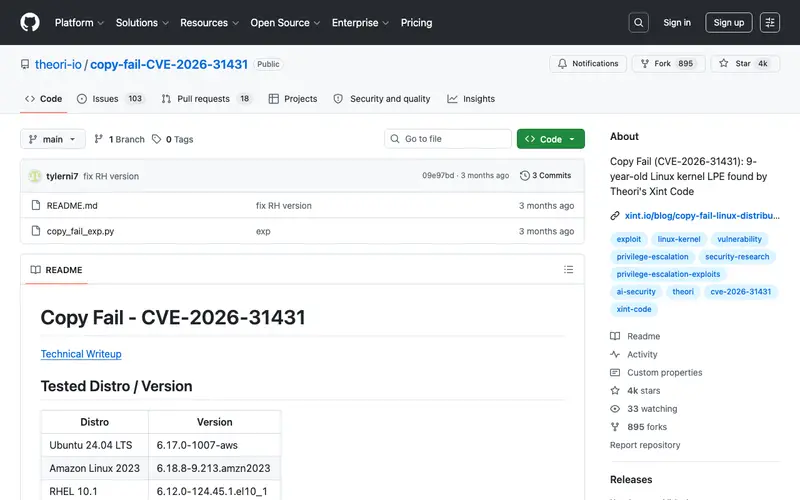
copy-fail-CVE-2026-31431 is a demonstration and proof-of-concept project detailing a critical Local Privilege Escalation (LPE) vulnerability discovered in the Linux kernel. This vulnerability, identified by Theori's Xint Code, exploits a flaw that has existed for approximately nine years. The project provides the necessary code and explanations for security researchers and system administrators to understand, reproduce, and potentially mitigate this significant security risk. It is hosted on GitHub and written in Python.
Editorial check
How this page is checked
Source trail
github.com
External links are separated from Surfaced commentary.
Reader safety
Context before clicks
Product links and external services are not presented as guarantees.
Monetization
No affiliate flag
Ads and commerce links are kept distinct from editorial text.
Surfaced take
Why It’s Useful
For cybersecurity professionals and system administrators, copy-fail-CVE-2026-31431 is an indispensable resource for understanding and defending against a long-standing and critical Linux kernel vulnerability. The availability of a working proof-of-concept allows for practical testing and verification of the exploit's behavior, which is crucial for developing effective patches and defensive measures. By shedding light on such deep-seated issues, it encourages proactive security practices and highlights the importance of continuous kernel auditing. This tool empowers security teams to assess their systems' exposure and implement necessary updates or workarounds, thereby significantly reducing the risk of unauthorized access and data breaches. Its existence contributes to a more robust and secure Linux ecosystem.
In everyday life
When you’d actually reach for this
You might use this when investigating a suspected security breach on a server you manage, or when reviewing the security posture of a new system before granting it elevated privileges. It's also relevant if you're a developer needing to understand how kernel vulnerabilities can impact your applications.





Enjoyed this? Get five picks like this every morning.
Free daily newsletter — zero spam, unsubscribe anytime.