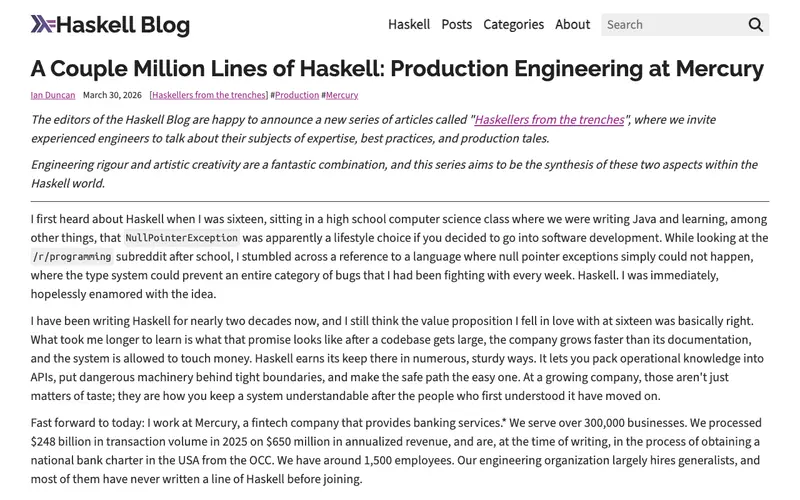
This article, 'A couple million lines of Haskell: Production engineering at Mercury,' details the sophisticated engineering practices at Mercury, a financial technology company known for its extensive reliance on the Haskell programming language. It meticulously explains how Mercury manages a massive codebase—reportedly millions of lines—of this functional language in a high-stakes, demanding production environment. The piece is primarily aimed at software engineers, architects, and engineering leaders keen on understanding real-world applications of functional programming at scale. It offers a deep dive into Mercury's unique architectural decisions, robust deployment strategies, continuous monitoring systems, and the custom tooling developed to support such a large and critical Haskell project. While not a tool itself, it serves as an invaluable case study for those looking to build highly reliable, maintainable, and performant systems using advanced functional paradigms.
Editorial check
How this page is checked
Source trail
blog.haskell.org
External links are separated from Surfaced commentary.
Reader safety
Context before clicks
Product links and external services are not presented as guarantees.
Monetization
No affiliate flag
Ads and commerce links are kept distinct from editorial text.
Surfaced take
Why It’s Useful
This article offers a rare and profound counter-narrative to the common perception that functional languages like Haskell are purely academic or unsuitable for large-scale enterprise production. For a senior software engineer, it provides concrete examples of how Haskell's type safety and concurrency features contribute to system reliability in a financial context, offering patterns and solutions for their own complex system designs. An engineering manager considering functional programming adoption can gain insights into the operational overhead, talent acquisition strategies, and long-term maintainability benefits that Mercury has achieved, informing strategic technology roadmap decisions. The article itself is free to access, making this highly valuable knowledge readily available. A key takeaway often discovered late is the significant investment Mercury made in building a strong engineering culture and bespoke tooling to enhance developer experience, proving that language choice is only one part of the equation for success. Despite the compelling evidence, Haskell's steep learning curve and smaller talent pool compared to mainstream languages like Java or Python limit its widespread adoption, making such success stories vital but niche. Mercury frequently shares engineering insights on its blog, indicating a commitment to evolving and documenting its production practices.
In everyday life
When you’d actually reach for this
You might reach for this when trying to understand how a complex, long-running system keeps up with demands. It's useful if you're inheriting a large, unfamiliar codebase and need insight into its maintenance. This article helps when considering how to scale and manage extensive code written in a less common language.







Enjoyed this? Get five picks like this every morning.
Free daily newsletter — zero spam, unsubscribe anytime.