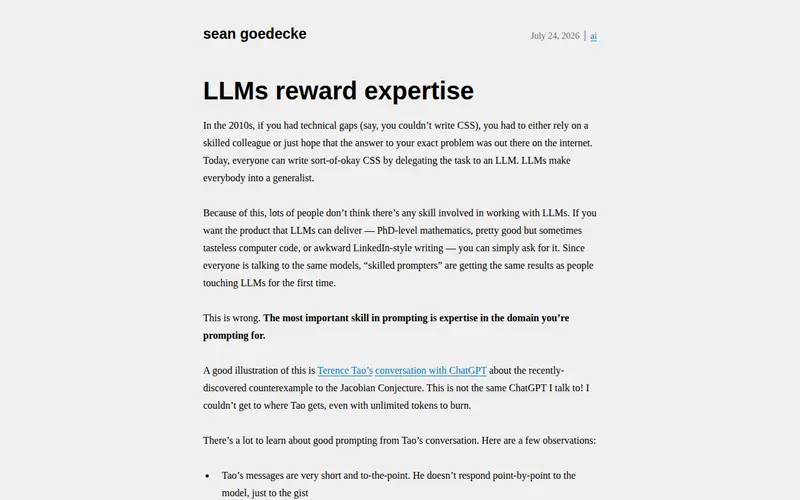
This article, originally posted on seangoedecke.com, delves into the nuanced relationship between Large Language Models (LLMs) and human expertise. It argues that while LLMs can generalize and access vast amounts of information, they truly excel and provide the most valuable output when guided by individuals with deep domain knowledge. The author suggests that the future of AI utilization lies not in replacing experts, but in augmenting their capabilities. A researcher, for instance, could use an LLM to quickly summarize complex papers, but their expertise is crucial for interpreting the findings and formulating new hypotheses.
Editorial check
How this page is checked
Source trail
seangoedecke.com
External links are separated from Surfaced commentary.
Reader safety
Context before clicks
Product links and external services are not presented as guarantees.
Monetization
No affiliate flag
Ads and commerce links are kept distinct from editorial text.
Surfaced take
Why It’s Useful
In an era where LLMs are becoming ubiquitous, this piece offers a critical perspective that cuts through the hype. It's a must-read for anyone in fields requiring specialized knowledge, from scientists and engineers to academics and creative professionals. The author provides a compelling case for why true innovation with AI will come from those who understand the 'why' behind the AI's output, not just the 'what'. It helps users understand that effective LLM prompting requires more than just asking a question; it demands context, critical thinking, and a solid understanding of the subject matter. This perspective is invaluable for optimizing AI integration into workflows, ensuring that AI serves as a powerful amplifier of human intellect rather than a superficial crutch.
In everyday life
When you’d actually reach for this
You're drafting a complex report and need to verify specific industry standards mentioned in your research notes. When planning a specialized hobby project, you want to ensure your technical approach aligns with the latest best practices from experienced practitioners.







Enjoyed this? Get five picks like this every morning.
Free daily newsletter — zero spam, unsubscribe anytime.