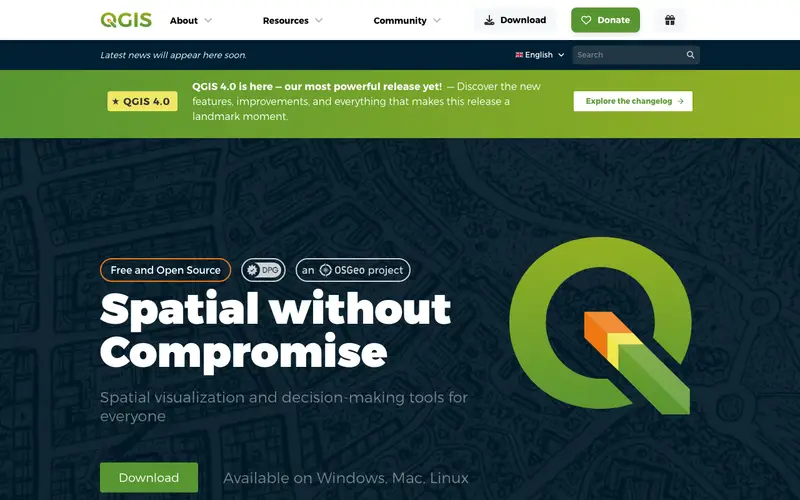
QGIS (formerly Quantum GIS) is a free and open-source cross-platform desktop geographic information system (GIS) application developed by a global community of volunteers. Its core feature is allowing users to create, edit, visualize, analyze, and publish geospatial information, supporting a vast array of vector, raster, and database formats. It is primarily built for geographers, environmental scientists, urban planners, data analysts, and anyone working with spatial data who needs professional-grade mapping and analysis capabilities without proprietary software costs. Users typically open QGIS when they need to combine different map layers, perform spatial queries, create custom maps for reports, or analyze geographical patterns. It integrates with numerous external plugins and databases like PostGIS and SpatiaLite, and works on Windows, macOS, Linux, Android, and iOS.
Editorial check
How this page is checked
Source trail
qgis.org
External links are separated from Surfaced commentary.
Reader safety
Context before clicks
Product links and external services are not presented as guarantees.
Monetization
No affiliate flag
Ads and commerce links are kept distinct from editorial text.
Surfaced take
Why It’s Useful
QGIS offers a robust alternative to expensive proprietary GIS software like ArcGIS, providing comparable functionality at no cost, making it better for accessible and collaborative geospatial work. For the urban planner analyzing demographic data, QGIS can overlay population density maps with zoning regulations and public transport routes to identify optimal development areas. For the environmental scientist tracking deforestation, it can process satellite imagery, calculate land cover changes, and visualize affected regions over time. QGIS is completely free and open-source, maintained by its community. A powerful feature often discovered later is its extensive Processing Toolbox, which provides access to hundreds of geoprocessing algorithms from other open-source projects like GDAL, GRASS GIS, and SAGA GIS. Its steep learning curve for beginners and the sheer breadth of its features can be intimidating, which contributes to it being a hidden gem outside specialized fields. It boasts a very active global community, frequent releases, and a massive plugin ecosystem.
In everyday life
When you’d actually reach for this
You might use QGIS to map out your neighborhood's flood zones before a big storm or to visualize property lines for a home renovation project. It's also useful for planning a hiking route by overlaying trail maps onto topographic data.






Enjoyed this? Get five picks like this every morning.
Free daily newsletter — zero spam, unsubscribe anytime.