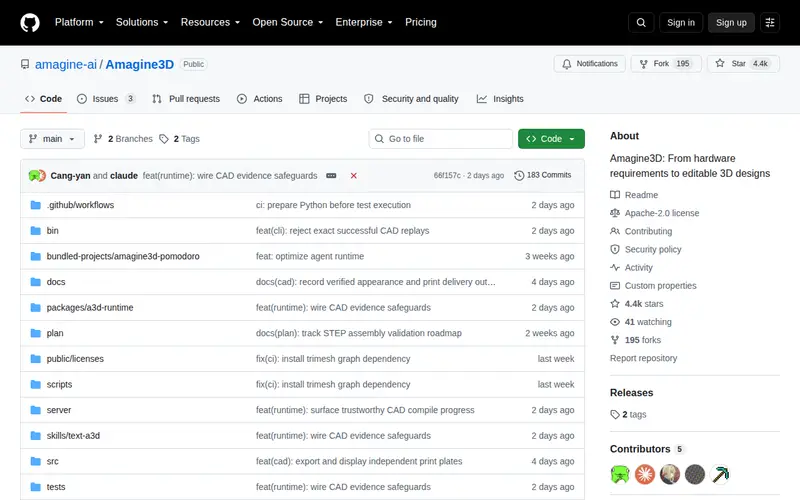
Amagine3D is an innovative Python library designed to bridge the gap between hardware requirements and editable 3D designs. It allows users to define and manipulate 3D objects and scenes programmatically, making it easier to generate complex geometric shapes and structures. This tool is particularly useful for researchers and developers who need to create and iterate on 3D models without relying on traditional manual design software. Its open-source nature makes it freely accessible for various applications.
Editorial check
How this page is checked
Source trail
github.com
External links are separated from Surfaced commentary.
Reader safety
Context before clicks
Product links and external services are not presented as guarantees.
Monetization
No affiliate flag
Ads and commerce links are kept distinct from editorial text.
Surfaced take
Why It’s Useful
For educators and students in fields like computer graphics, engineering, and architecture, Amagine3D offers a powerful way to learn and experiment with 3D design through code. It democratizes the creation of intricate 3D models, moving beyond the typical limitations of graphical interfaces. The library's ability to generate designs based on specific hardware constraints is groundbreaking for optimizing real-world applications. Its integration into Python environments makes it accessible to a wide audience already familiar with the language, fostering rapid prototyping and learning.
In everyday life
When you’d actually reach for this
When you're learning about computational geometry, you might use Amagine3D to write a script that generates complex fractal patterns or to visualize data in three dimensions. It's perfect for creating custom 3D models for science projects or for exploring algorithmic art.







Enjoyed this? Get five picks like this every morning.
Free daily newsletter — zero spam, unsubscribe anytime.