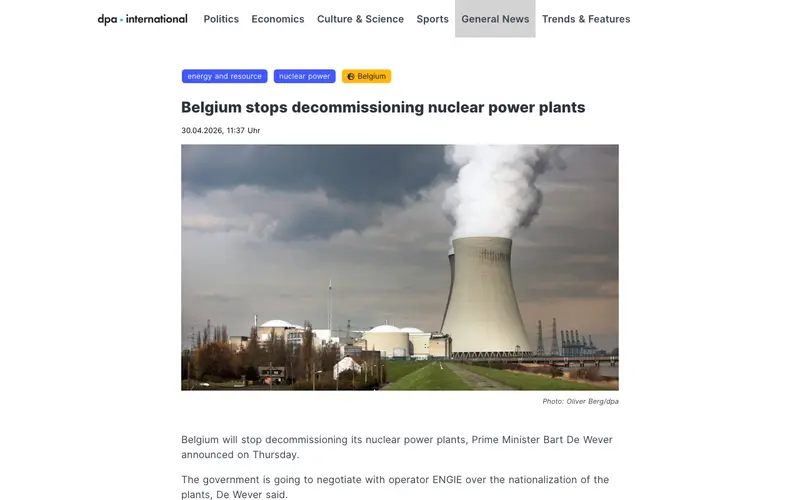
This news article, likely from a reputable international news agency, reports on a critical policy reversal by the Belgian government regarding its long-standing nuclear phase-out plan. It details the decision to halt the decommissioning of two key nuclear reactors—Doel 4 and Tihange 3—and instead extend their operational lifespan by an additional 10 years, through 2035. The report is vital for energy policymakers, environmental strategists, energy industry analysts, international relations experts, and citizens concerned with national energy security and climate change. This information serves as a crucial data point for understanding the evolving energy landscape in Europe, informing discussions on energy independence, the role of nuclear power in decarbonization, and responses to geopolitical energy crises (e.g., impact of the 2022 Russian invasion of Ukraine). As a news report, it synthesizes information from government announcements, expert analyses, and potentially public and industry reactions, providing a comprehensive overview of the policy shift.
Editorial check
How this page is checked
Source trail
dpa-international.com
External links are separated from Surfaced commentary.
Reader safety
Context before clicks
Product links and external services are not presented as guarantees.
Monetization
No affiliate flag
Ads and commerce links are kept distinct from editorial text.
Surfaced take
Why It’s Useful
This piece provides a concrete, real-world example of how energy policy can shift rapidly in response to external pressures, offering more depth than abstract policy papers or general debates about energy sources. It highlights the pragmatic challenges of transitioning to renewables while maintaining baseload power. An analyst working for an international energy agency can cite Belgium's decision as a case study for how nations are re-evaluating nuclear power's role in achieving both energy security and climate goals, especially in the wake of the European energy crisis. An environmental advocate can use this report to understand the complex trade-offs involved in energy decisions, framing arguments for or against nuclear power extension based on factors like carbon emissions, waste management, and energy independence. Depending on the news source, the article might be freely accessible or behind a paywall, typical for in-depth reporting from major news organizations. The decision involved intense political negotiations and a significant financial commitment (estimated in the billions of euros for safety upgrades and operational extensions), often revealing the true economic and political complexity behind such policy pivots. While critical for specific audiences, news about national energy policy, particularly nuclear power, often remains niche compared to more immediate consumer-focused news, despite its long-term impact on energy prices and climate targets. As a breaking news item, it's a snapshot in time. However, major news outlets provide ongoing coverage of energy policy and geopolitical developments, with follow-up articles and analyses appearing regularly.
In everyday life
When you’d actually reach for this
You might reach for this when reviewing your household energy budget for the month. It's also useful when planning a group trip and discussing the projected energy costs or availability in a region.







Enjoyed this? Get five picks like this every morning.
Free daily newsletter — zero spam, unsubscribe anytime.