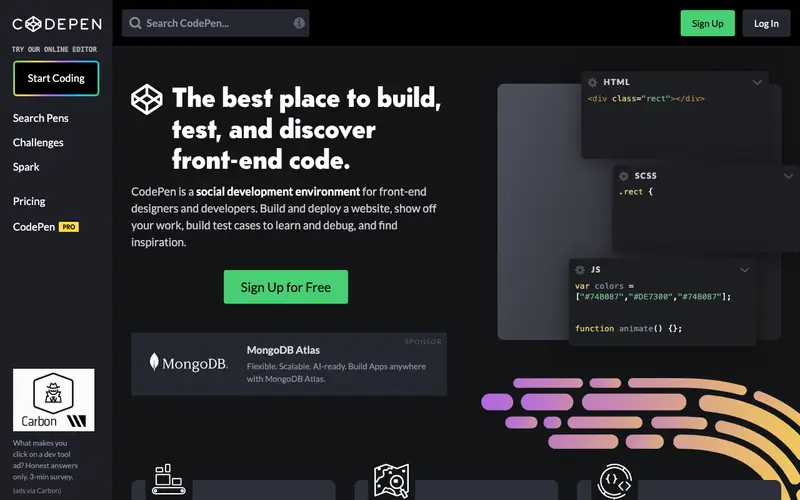
CodePen is an online social development environment, founded by Chris Coyier, Alex Vazquez, and Tim Sabat, primarily for front-end developers to write, test, and showcase HTML, CSS, and JavaScript snippets. It functions as a powerful browser-based code editor and a community platform for sharing "Pens" (interactive code snippets or small projects). The primary workflow involves writing code in separate HTML, CSS, and JS panels, seeing the live output instantly, and then saving or sharing the interactive result. It works entirely in a web browser, making it universally accessible. Its most used feature is the live preview, allowing developers to experiment and see changes in real-time. All Pens are stored in the cloud, linked to your user account, enabling easy access and sharing.
Editorial check
How this page is checked
Source trail
codepen.io
External links are separated from Surfaced commentary.
Reader safety
Context before clicks
Product links and external services are not presented as guarantees.
Monetization
No affiliate flag
Ads and commerce links are kept distinct from editorial text.
Surfaced take
Why It’s Useful
CodePen eliminates the friction of setting up local development environments for small experiments or sharing visual code snippets, fostering rapid prototyping and collaboration. For the front-end developer, it's an indispensable tool for quickly testing CSS properties, JavaScript animations, or HTML structures without leaving the browser. For the technical educator or content creator, it provides an excellent platform for creating interactive code examples and tutorials that can be easily embedded or shared. The free tier is incredibly useful, offering unlimited public pens and basic features, while paid "Pro" accounts unlock private pens, asset hosting, and collaborative features. CodePen surpasses static code snippet managers by offering a live, interactive environment where code actually runs, making it perfect for demonstrating dynamic examples. A power feature is its extensive library of preprocessors and external script/stylesheet includes, enabling complex projects with minimal setup. Anyone with basic web development knowledge can start coding and saving their first "Pen" within a couple of minutes.
In everyday life
When you’d actually reach for this
You need to quickly mock up a visual concept for a colleague before a meeting. You want to share a small, interactive animation idea with friends planning a weekend getaway. You have a few interesting code examples bookmarked and want to save them in one place to review later.






Enjoyed this? Get five picks like this every morning.
Free daily newsletter — zero spam, unsubscribe anytime.