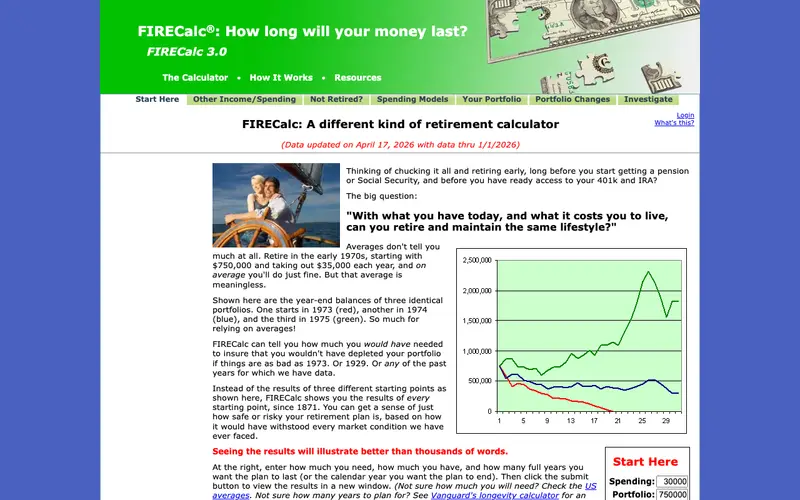
FIRECalc is a free, web-based retirement planning tool built by a community of financial independence enthusiasts, specifically for those pursuing the 'Financial Independence, Retire Early' (FIRE) movement. Its core feature is its ability to simulate the success rate of a retirement plan by running it through every historical market period in U.S. history, including various economic conditions like depressions and hyperinflation. The primary user is anyone planning for early retirement or wanting to understand the probability of their financial resources lasting throughout their retirement years. Users typically turn to FIRECalc after calculating their target 'FIRE number' and want to validate their safe withdrawal rate and portfolio longevity. It operates entirely within a web browser, requiring users to input their financial parameters, and does not connect to external financial accounts.
Editorial check
How this page is checked
Source trail
firecalc.com
External links are separated from Surfaced commentary.
Reader safety
Context before clicks
Product links and external services are not presented as guarantees.
Monetization
No affiliate flag
Ads and commerce links are kept distinct from editorial text.
Surfaced take
Why It’s Useful
Unlike traditional retirement calculators that use linear projections or simplified averages, FIRECalc leverages historical market data to provide a much more robust and realistic assessment of retirement plan success, making it superior for long-term, dynamic planning. For the young professional aiming to retire by 40, FIRECalc offers confidence by demonstrating that their planned withdrawal rate and portfolio size have a high historical success rate, even through past economic downturns. For the couple nearing their FIRE date, it allows them to fine-tune their spending and investment strategy by testing different scenarios, such as varying their retirement age or adjusting their asset allocation. FIRECalc is entirely free and open for public use, embodying the spirit of the FIRE community. A 'hidden' feature is the ability to adjust for 'pensions' or 'social security' at later ages, providing a more nuanced long-term projection. Its minimalist interface and specific focus on historical simulations rather than active budgeting tools means it appeals mainly to the analytically-minded FIRE community, limiting its mainstream adoption. The tool is maintained by a dedicated group of volunteers and is regularly updated with new data and minor feature improvements.
In everyday life
When you’d actually reach for this
You're dreaming about early retirement and want to see if your current savings strategy might actually work. Maybe you're planning a big vacation and wonder if the cost will derail your long-term financial goals. You're also curious to see how a market downturn might impact your projected retirement date.







Enjoyed this? Get five picks like this every morning.
Free daily newsletter — zero spam, unsubscribe anytime.