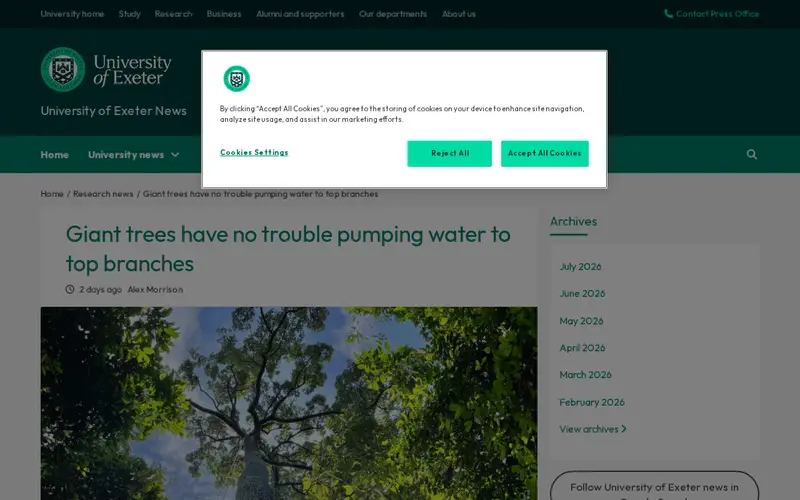
This research from the University of Exeter sheds new light on how colossal trees, some reaching over 100 meters tall, efficiently transport water from their roots to their highest leaves. The study, published in a scientific journal, challenges previous assumptions by demonstrating that a combination of capillary action and the physical structure of the tree's vascular system plays a crucial role. It investigates the forces at play, including negative pressure and structural integrity, that allow these giants to defy gravity. This finding has implications for understanding plant physiology, forest ecosystems, and potentially bio-inspired engineering.
Editorial check
How this page is checked
Source trail
news.exeter.ac.uk
External links are separated from Surfaced commentary.
Reader safety
Context before clicks
Product links and external services are not presented as guarantees.
Monetization
No affiliate flag
Ads and commerce links are kept distinct from editorial text.
Surfaced take
Why It’s Useful
Beyond its intrinsic scientific interest, this research offers a fascinating glimpse into nature's engineering prowess, which often inspires human innovation. For students, biologists, and engineers, understanding the mechanisms by which giant trees overcome such a significant physical challenge can spark new ideas in fluid dynamics, material science, and even pump design. It's a reminder that nature has solved complex problems over millennia. The detailed scientific breakdown of water transport in these massive organisms provides a unique perspective, distinct from general ecological articles, appealing to those who appreciate the intricate details of the natural world and its potential applications.
In everyday life
When you’d actually reach for this
You might look this up while planning a garden that includes tall trees, or when explaining a complex natural phenomenon to a child. It's also useful for understanding the science behind why certain plants thrive in different environments.







Enjoyed this? Get five picks like this every morning.
Free daily newsletter — zero spam, unsubscribe anytime.