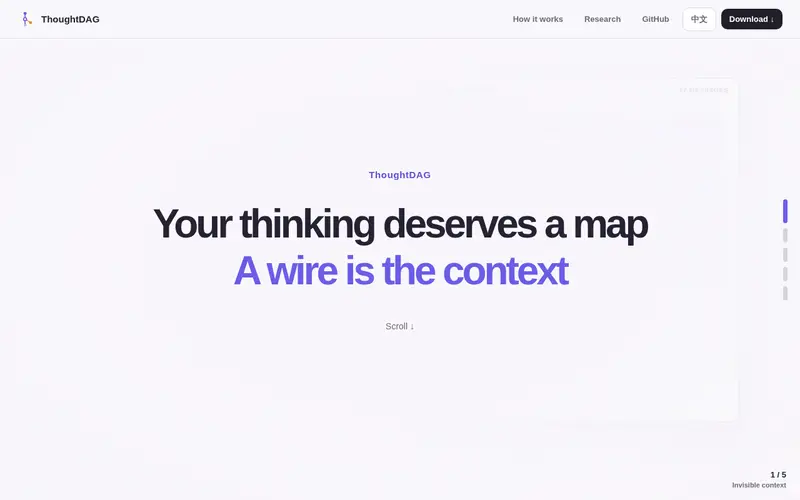
ThoughtDAG is an experimental, editable context graph designed for managing and visualizing Large Language Model (LLM) conversations. It helps users organize their interactions with AI by representing each turn as a node in a directed acyclic graph, allowing for branching, editing, and revisiting specific points in a conversation. This is particularly useful for complex research, brainstorming sessions, or when trying to maintain coherence across extended LLM dialogues. It was developed by Chenxi Chen.
Editorial check
How this page is checked
Source trail
chenxiachan.github.io
External links are separated from Surfaced commentary.
Reader safety
Context before clicks
Product links and external services are not presented as guarantees.
Monetization
No affiliate flag
Ads and commerce links are kept distinct from editorial text.
Surfaced take
Why It’s Useful
While many tools offer simple chat histories, ThoughtDAG elevates conversation management by providing a visual, navigable structure. Its true power lies in its editability; you can modify previous thoughts or re-route branches, allowing for a more iterative and experimental approach to AI interaction. This is invaluable for users who don't just want a transcript but a tool to actively sculpt and refine their AI-assisted thinking. Power users of LLMs for creative writing, coding, or deep research will find it a game-changer for maintaining clarity and exploring alternative paths without losing track of the original context.
In everyday life
When you’d actually reach for this
When you're deep into researching a complex topic with an AI, use ThoughtDAG to visually map out your questions and the AI's answers. If an answer leads you down a new, interesting but unrelated path, you can branch off without losing your original line of inquiry. Later, you can easily return to the main thread or explore the side branch.





Enjoyed this? Get five picks like this every morning.
Free daily newsletter — zero spam, unsubscribe anytime.