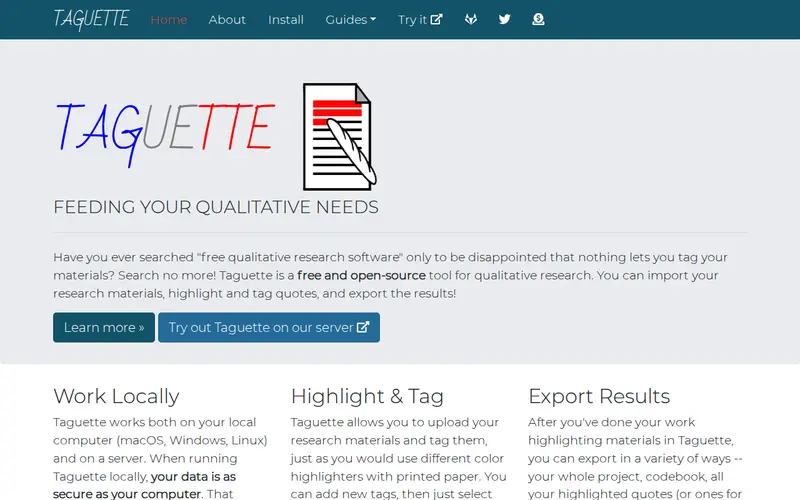
Taguette is a free and open-source desktop application designed for qualitative data analysis. It allows users to code and annotate text documents, making it easier to identify themes and patterns within qualitative research data like interview transcripts or field notes. It prioritizes user privacy and data control, as all analysis happens locally on your machine. This tool is especially valuable for researchers and students who require robust qualitative analysis capabilities without the cost of proprietary software.
Editorial check
How this page is checked
Source trail
taguette.org
External links are separated from Surfaced commentary.
Reader safety
Context before clicks
Product links and external services are not presented as guarantees.
Monetization
No affiliate flag
Ads and commerce links are kept distinct from editorial text.
Surfaced take
Why It’s Useful
Taguette empowers researchers working with textual data by providing intuitive tools for coding and thematic analysis. Unlike cloud-based services, it ensures your sensitive data remains private and secure on your local system. Its straightforward interface makes it accessible even for those new to qualitative analysis, while its powerful features support complex coding schemes. It excels at managing large volumes of text and facilitating collaborative analysis among research teams. Users appreciate its reliability and the freedom it offers from subscription fees, making rigorous qualitative research more accessible.
In everyday life
When you’d actually reach for this
After conducting interviews for a project, you can import the transcripts into Taguette. You'd then highlight and assign codes to recurring ideas or themes, helping you organize and identify key insights for your report or presentation.







Enjoyed this? Get five picks like this every morning.
Free daily newsletter — zero spam, unsubscribe anytime.