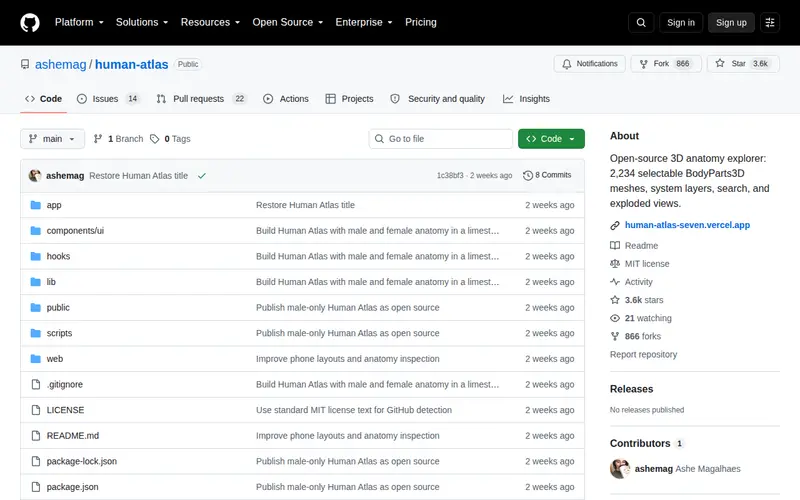
Human Atlas is an open-source 3D anatomy explorer that provides a detailed and interactive visualization of the human body. It features over 2,300 selectable BodyParts3D meshes, allowing users to isolate and examine specific anatomical structures. The tool includes system layers for understanding organ and tissue organization and offers search functionalities and exploded views for deeper exploration. It's built with TypeScript, making it a modern and efficient web-based application for anatomical study.
Editorial check
How this page is checked
Source trail
github.com
External links are separated from Surfaced commentary.
Reader safety
Context before clicks
Product links and external services are not presented as guarantees.
Monetization
No affiliate flag
Ads and commerce links are kept distinct from editorial text.
Surfaced take
Why It’s Useful
This tool is invaluable for students, educators, and healthcare professionals who need a comprehensive and accessible way to learn about human anatomy. The ability to interact with detailed 3D models, switch between different body systems, and search for specific parts offers a more engaging and effective learning experience than static diagrams. Its open-source nature encourages community contributions and ensures continuous improvement, making it a reliable and evolving resource for anyone involved in anatomical education or research. The exploded views are particularly useful for understanding spatial relationships.
In everyday life
When you’d actually reach for this
If you're a student studying for an anatomy exam, you can use Human Atlas to visualize complex muscle groups or organ systems in 3D, helping you understand their positions and connections before your next test.






Enjoyed this? Get five picks like this every morning.
Free daily newsletter — zero spam, unsubscribe anytime.