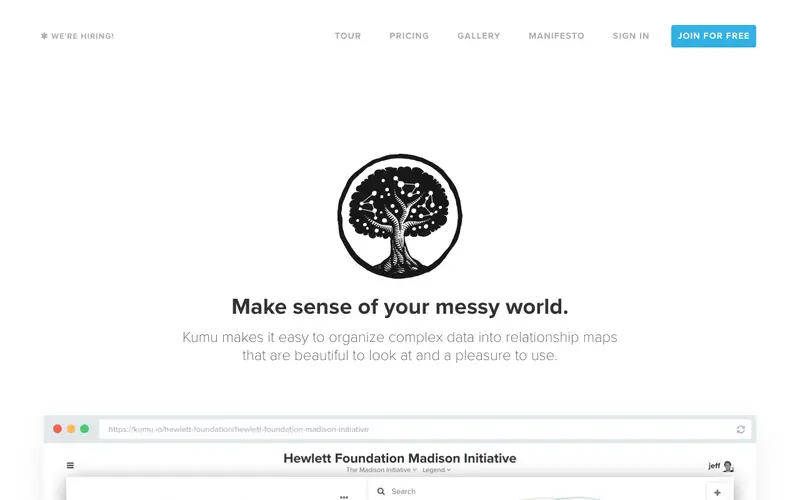
Kumu is a powerful online platform, developed by a small team, for mapping relationships, systems, and networks. Its core functionality allows users to visualize complex interconnections between entities, revealing patterns, feedback loops, and influence dynamics in a highly interactive way. It's primarily designed for systems thinkers, organizational development consultants, researchers, and community organizers who need to understand and communicate intricate relationships. Users typically turn to Kumu when they're grappling with a messy, interconnected problem—like stakeholder mapping, causal loop diagrams, or social network analysis—and want to bring clarity to its structure. Kumu supports data import from spreadsheets and integrates with tools like Zapier for automated updates.
Editorial check
How this page is checked
Source trail
kumu.io
External links are separated from Surfaced commentary.
Reader safety
Context before clicks
Product links and external services are not presented as guarantees.
Monetization
No affiliate flag
Ads and commerce links are kept distinct from editorial text.
Surfaced take
Why It’s Useful
While tools like Lucidchart offer basic diagramming, Kumu goes far beyond static visuals by enabling deep, interactive exploration of dynamic systems, making it a superior choice for true systems thinking. For the consultant mapping a complex organization, Kumu lets them visualize power structures and information flows, identifying key leverage points. A public health researcher can use it to track disease transmission networks or analyze policy influence, revealing hidden connections that static charts miss. Kumu offers a generous free tier for public projects and paid plans for private work and advanced features. A powerful feature often discovered later is "decorations," allowing users to dynamically style elements based on data attributes, making complex maps instantly readable. Its specialized focus on relational mapping rather than general-purpose charting means it's a niche tool, preventing it from reaching mainstream popularity. Kumu has a vibrant community, extensive documentation, and a continuous development cycle with frequent feature enhancements.
In everyday life
When you’d actually reach for this
You're trying to understand how your family's spending habits influence each other during a tough budget month. When planning a group trip with friends, you need to untangle who owes what and who's responsible for booking what. You also reach for it when preparing to hand off projects before your annual leave, ensuring everyone knows the connections.







Enjoyed this? Get five picks like this every morning.
Free daily newsletter — zero spam, unsubscribe anytime.