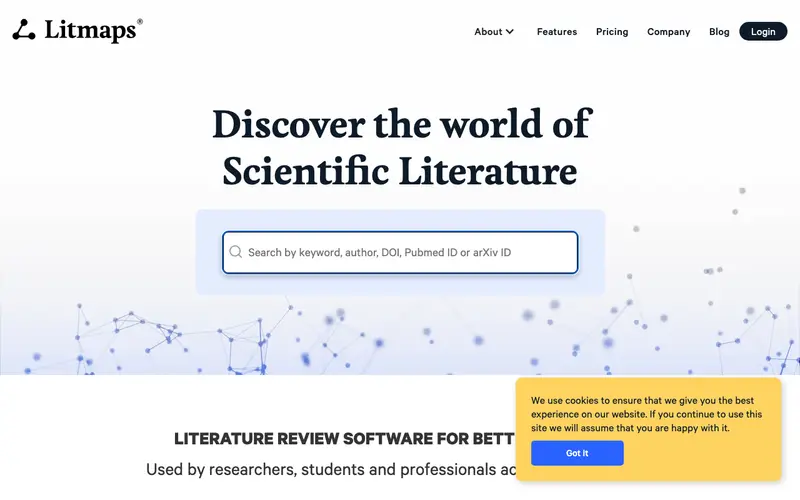
Litmaps is a powerful web application developed by a team of researchers and software engineers, designed to help academics discover and visualize the interconnectedness of scientific literature. Its core feature is the ability to generate interactive "seed maps" from a starting paper, showing related articles, citing papers, and cited papers in a dynamic graph. This tool is primarily built for researchers, graduate students, and anyone undertaking a comprehensive literature review. It becomes invaluable when a user has a foundational paper and needs to explore its lineage and subsequent impact, or identify emerging research fronts. Litmaps primarily works through its web interface, leveraging academic databases to build its connections.
Editorial check
How this page is checked
Source trail
litmaps.com
External links are separated from Surfaced commentary.
Reader safety
Context before clicks
Product links and external services are not presented as guarantees.
Monetization
No affiliate flag
Ads and commerce links are kept distinct from editorial text.
Surfaced take
Why It’s Useful
Litmaps excels where traditional database searches or even tools like Google Scholar fall short, by visually demonstrating the relationships between papers rather than just listing them. For the early-career researcher starting a new project, it provides an intuitive way to map out a research area, identifying key foundational works and influential follow-ups. For a seasoned academic, it can reveal unexpected connections or gaps in their own knowledge of a field. Litmaps offers a generous free tier for basic map generation and exploration, with paid plans unlocking more advanced features like larger maps, saved collections, and collaboration. A standout feature, often overlooked, is its "growth maps" which show how a research area has evolved over time, helping identify trends. Its niche nature and the learning curve associated with interpreting complex visual networks contribute to its status as a hidden gem, despite its immense utility for specific research tasks. Litmaps maintains an active blog with research tips and receives regular updates.
In everyday life
When you’d actually reach for this
You're trying to find more background for a presentation and those tabs you swore you'd read are overwhelming. When planning a group trip and needing to quickly understand the landscape of potential destinations, you might use it. It's helpful when you need to get up to speed on a new area before a colleague hands off a project.





Enjoyed this? Get five picks like this every morning.
Free daily newsletter — zero spam, unsubscribe anytime.