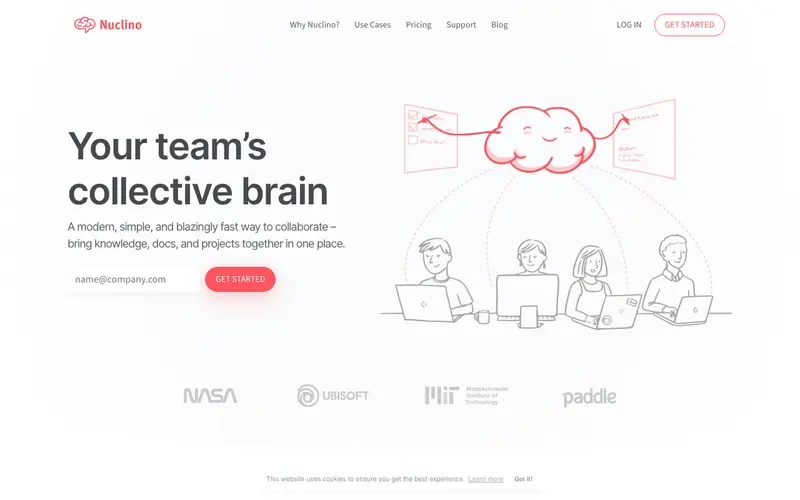
Nuclino is a unified workspace developed by a European startup that combines wikis, documents, and project management into a single, collaborative platform. Its core feature is a real-time collaborative editor that allows teams to create, organize, and share knowledge quickly and efficiently. It was built primarily for remote and hybrid teams seeking a centralized hub for documentation, brainstorming, and project tracking. Teams typically open Nuclino when they need to document a new process, share project updates, or collaboratively draft a strategy. It integrates with popular tools like Slack, Google Drive, and Figma, and is available on web, desktop (Windows, macOS, Linux), and mobile.
Editorial check
How this page is checked
Source trail
nuclino.com
External links are separated from Surfaced commentary.
Reader safety
Context before clicks
Product links and external services are not presented as guarantees.
Monetization
No affiliate flag
Ads and commerce links are kept distinct from editorial text.
Surfaced take
Why It’s Useful
While Notion offers similar functionalities, Nuclino stands out for its extreme simplicity and focus on speed, making it superior for teams that prioritize quick knowledge capture and easy navigation without getting bogged down by complex database features. For the startup founder who needs to onboard new hires quickly, Nuclino provides a streamlined wiki for company policies and project overviews, getting new team members up to speed in hours, not days. For the agile development team, it serves as a lightweight sprint planning and documentation tool, where user stories and meeting notes live alongside code snippets. Nuclino offers a free plan for up to 50 items and 3 workspaces, with paid plans unlocking unlimited items and advanced features like version history and integrations. A hidden gem is its "collections" feature, which allows dynamic organization of related documents without rigid folder structures, making content discovery much more intuitive. It’s not more popular because it often gets overshadowed by giants like Notion and Confluence, despite its focused excellence for documentation-heavy teams. They maintain a consistent update cadence, often adding small, impactful features based on user feedback.






Enjoyed this? Get five picks like this every morning.
Free daily newsletter — zero spam, unsubscribe anytime.