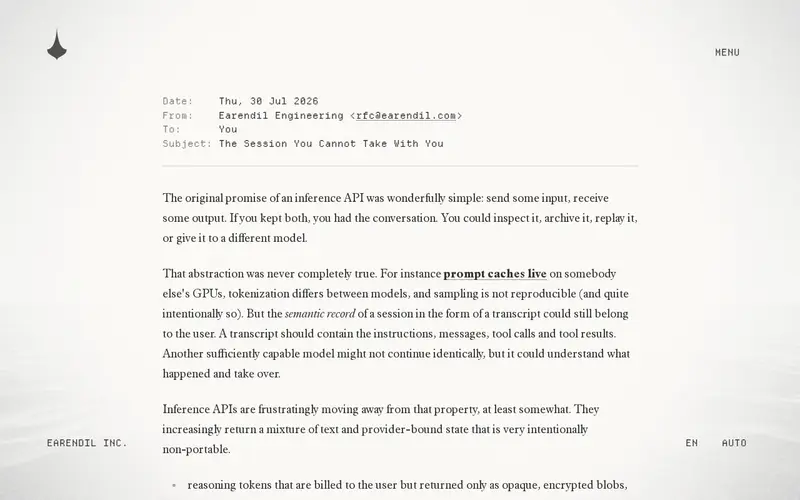
This essay delves into the concept of session portability in software development, exploring the challenges and implications of creating user sessions that can seamlessly transition across different devices, platforms, and even application states. It discusses the technical hurdles, architectural patterns, and the user experience benefits of achieving true session continuity. The piece is aimed at developers and product designers interested in building more robust and user-friendly applications.
Editorial check
How this page is checked
Source trail
earendil.com
External links are separated from Surfaced commentary.
Reader safety
Context before clicks
Product links and external services are not presented as guarantees.
Monetization
No affiliate flag
Ads and commerce links are kept distinct from editorial text.
Surfaced take
Why It’s Useful
While many applications aim for cross-device functionality, true session portability—where a user's exact state and context are preserved and transferable—remains a complex and often overlooked challenge. This article provides a deep dive into the intricacies, offering valuable insights for developers striving to create truly fluid user experiences. It's not just about saving progress, but about maintaining the entire interactive context. For developers building complex applications, distributed systems, or services that span multiple touchpoints, understanding these principles can lead to significant improvements in user satisfaction and application stickiness.
In everyday life
When you’d actually reach for this
You're on your commute home and want to pick up that coding project from your laptop on your phone. Or perhaps you're handing off your work to a colleague before a vacation and need them to seamlessly continue where you left off. You might even be trying to revisit that complex query you started on your desktop this morning from your tablet.





Enjoyed this? Get five picks like this every morning.
Free daily newsletter — zero spam, unsubscribe anytime.