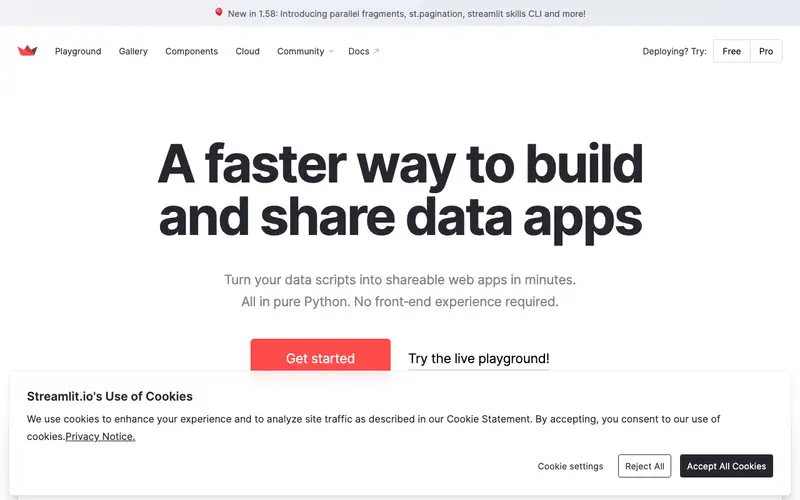
Streamlit is an open-source Python library created by a startup (now part of Snowflake) that allows data scientists and machine learning engineers to build and deploy interactive web applications with pure Python. Its core feature is turning data scripts into shareable web apps with minimal code, allowing for quick prototyping and demonstration of data projects, models, and visualizations. It was primarily built for Python users who want to present their data insights and interactive models to non-technical stakeholders without needing web development expertise. A user opens Streamlit when they have a Python script that generates insights or a model, and they want to add sliders, buttons, and text inputs to make it interactive and easily shareable. It integrates seamlessly with popular Python libraries like Pandas, Matplotlib, Plotly, Scikit-learn, and more, and can be deployed on various cloud platforms.
Editorial check
How this page is checked
Source trail
streamlit.io
External links are separated from Surfaced commentary.
Reader safety
Context before clicks
Product links and external services are not presented as guarantees.
Monetization
No affiliate flag
Ads and commerce links are kept distinct from editorial text.
Surfaced take
Why It’s Useful
Compared to building a custom web application with Flask/Django, Streamlit offers a dramatically faster way to create interactive data dashboards and tools, making it better for rapid iteration and internal sharing. For the data scientist needing to demonstrate a predictive model, Streamlit allows them to build an interactive demo in hours, not days, letting users input parameters and see real-time predictions. For the researcher sharing analysis results, it can create a dynamic report where others can filter data or adjust visualization parameters. Streamlit is free and open-source, though Snowflake offers paid hosting solutions. A useful feature often overlooked is `st.experimental_memo` and `st.experimental_singleton` for efficient caching, significantly speeding up complex apps. Its Python-only nature can limit broader web integration, contributing to its "hidden gem" status outside the Python community, despite its immense utility for data professionals. It boasts a large and active community, frequent updates, and a rich ecosystem of custom components.
In everyday life
When you’d actually reach for this
You need to quickly show your team the results of a recent sales analysis. Or perhaps you want to build a simple tool to track your personal budget before a big purchase. You might also use it to create a quick interactive dashboard for a friend's upcoming event planning.







Enjoyed this? Get five picks like this every morning.
Free daily newsletter — zero spam, unsubscribe anytime.