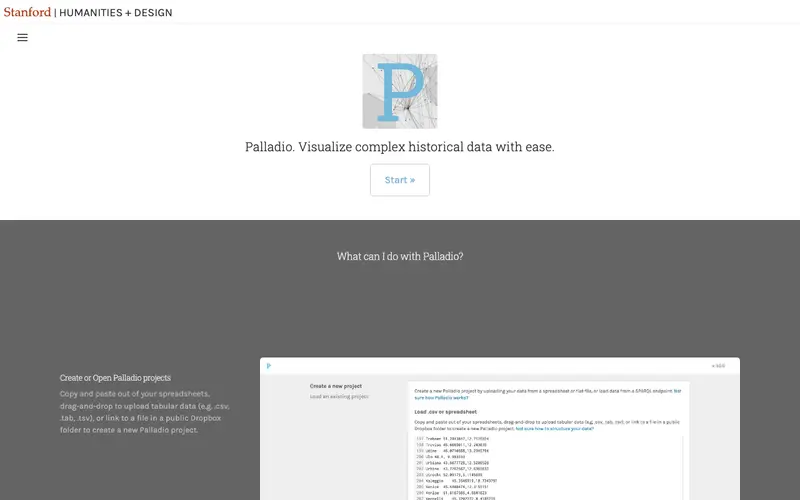
Palladio is a powerful open-source web-based tool developed by the Stanford University Humanities + Design Lab, designed for visualizing complex historical and cultural data. It allows users to upload tabular data and explore relationships, timelines, and geographical patterns through interactive graphs, maps, and lists. The core feature lies in its ability to quickly switch between different visualization modes to uncover hidden connections in unstructured or semi-structured datasets. It's primarily built for researchers, historians, and digital humanities scholars who need to make sense of intricate archives and collections. Users typically open Palladio when they have a spreadsheet of people, places, events, or objects and want to visually discover patterns without coding. It works directly in your web browser and doesn't require any specific integrations.
Editorial check
How this page is checked
Source trail
hdlab.stanford.edu
External links are separated from Surfaced commentary.
Reader safety
Context before clicks
Product links and external services are not presented as guarantees.
Monetization
No affiliate flag
Ads and commerce links are kept distinct from editorial text.
Surfaced take
Why It’s Useful
While mainstream tools like Excel or Google Sheets can organize tabular data, Palladio excels at revealing the *relationships* within that data, making it superior for exploratory analysis of interconnected entities. For the historian analyzing correspondence networks, Palladio can map who wrote to whom over time, pinpointing key figures and periods of intense communication. For the literary scholar studying character appearances, it can visualize co-occurrences in texts, showing character clusters and their evolution. Palladio is completely free and open-source, with no paid tiers. A feature often discovered later is its powerful facet and filter system, allowing highly granular exploration of subsets within the visualization. Its niche focus on humanities data, combined with a non-code approach, makes it less popular than broader BI tools, but invaluable for its target audience. It is actively maintained by Stanford and has a supportive community of digital humanities practitioners.
In everyday life
When you’d actually reach for this
You're trying to map out the family tree for a reunion and need to see how everyone connects. Or perhaps you're planning a group trip and want to visualize potential travel routes and costs. You might also be reviewing research papers you saved and want to see how different concepts relate.







Enjoyed this? Get five picks like this every morning.
Free daily newsletter — zero spam, unsubscribe anytime.