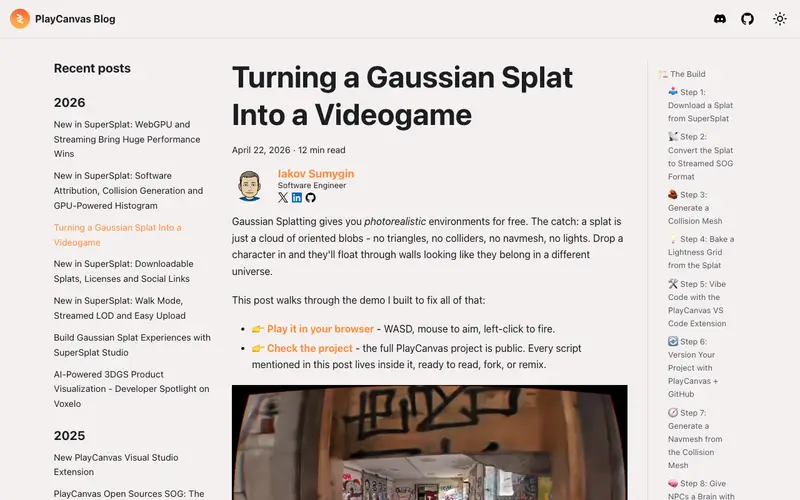
This blog post and accompanying resources detail how to transform a Gaussian Splatting representation of a 3D scene into an interactive videogame using the PlayCanvas engine. Gaussian Splatting is a novel technique for rendering 3D scenes from images, and this guide shows how to import and utilize these splats within a game development environment. It's a technical tutorial aimed at game developers and 3D artists interested in leveraging cutting-edge rendering techniques in their projects.
Editorial check
How this page is checked
Source trail
blog.playcanvas.com
External links are separated from Surfaced commentary.
Reader safety
Context before clicks
Product links and external services are not presented as guarantees.
Monetization
No affiliate flag
Ads and commerce links are kept distinct from editorial text.
Surfaced take
Why It’s Useful
For game developers interested in the bleeding edge of 3D rendering and asset integration, this is an invaluable resource. Gaussian Splatting offers a new paradigm for capturing and rendering 3D environments, and learning how to bring these into a game engine like PlayCanvas opens up exciting possibilities for realistic visuals and faster scene creation. It bridges the gap between novel research in 3D reconstruction and practical game development, offering a concrete workflow for using these advanced techniques. Developers looking to experiment with photorealistic assets or explore new rendering pipelines will find this highly beneficial.
In everyday life
When you’d actually reach for this
You're curious about how to bring those impressive Gaussian Splatting demos into a playable experience. Perhaps you're looking for a new way to visualize scanned environments in an interactive format. You might also be exploring cutting-edge rendering techniques for your next game project.





Enjoyed this? Get five picks like this every morning.
Free daily newsletter — zero spam, unsubscribe anytime.