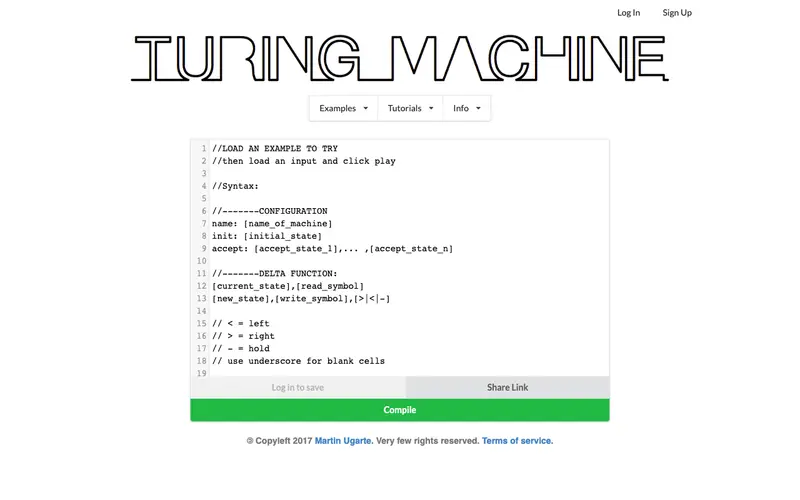
Turing Machine Simulator is a free, web-based educational tool created by researchers and educators to help visualize and interact with Turing machines. It provides an intuitive graphical interface for designing, running, and debugging Turing machine programs, step-by-step. The tool is specifically built for computer science students, educators, and anyone interested in understanding the fundamental concepts of computation and algorithms. A user accesses this simulator when they are learning theoretical computer science, particularly finite automata, computability, or algorithm design, and need a hands-on experience. It is a standalone web application, focused purely on its simulation function without external integrations.
Editorial check
How this page is checked
Source trail
turingmachinesimulator.com
External links are separated from Surfaced commentary.
Reader safety
Context before clicks
Product links and external services are not presented as guarantees.
Monetization
No affiliate flag
Ads and commerce links are kept distinct from editorial text.
Surfaced take
Why It’s Useful
Unlike merely reading textbooks or watching lectures, this simulator provides an interactive, visual sandbox for Turing machines, offering a superior practical understanding of theoretical computer science concepts. For a computer science student struggling to grasp the abstract idea of an algorithm, it offers a concrete way to build and watch a simple program execute. An educator can use it in a classroom to demonstrate complex computational principles in real-time, engaging students with visual feedback. The entire tool is completely free and open-source, making it accessible to anyone with an internet connection. A feature often overlooked initially is the ability to save and load custom Turing machine definitions, allowing users to build a library of examples and share complex machines. Its highly specialized nature for a niche academic topic means it's not widely known outside of computer science education circles. The project is maintained by its open-source community, seeing occasional updates and improvements based on user feedback.
In everyday life
When you’d actually reach for this
When you're trying to grasp a complex computer science concept for a class assignment, or if you're curious about how simple machines can perform calculations. This tool helps demystify abstract theories.







Enjoyed this? Get five picks like this every morning.
Free daily newsletter — zero spam, unsubscribe anytime.