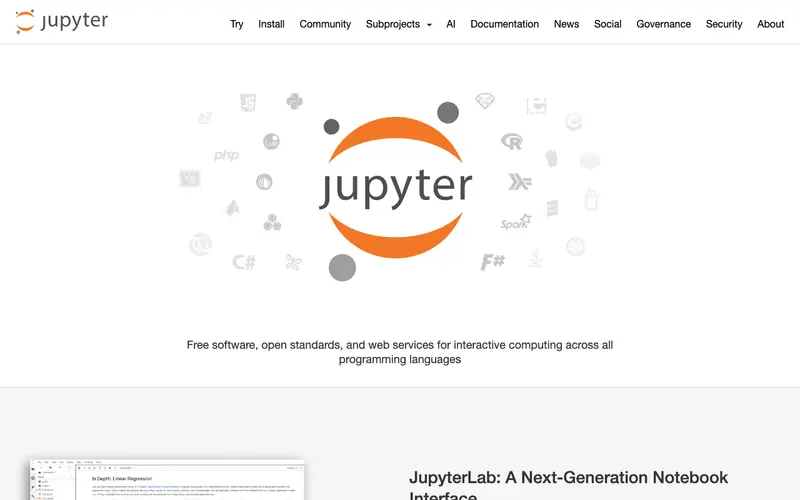
Project Jupyter provides open-source software, interactive computing environments, and data science tools. Its flagship product, Jupyter Notebook, allows users to create and share documents that contain live code, equations, visualizations, and narrative text. This makes it incredibly powerful for data exploration, statistical modeling, machine learning, and scientific research, enabling reproducible workflows. Data scientists, researchers, and educators use it daily to analyze data and communicate findings.
Editorial check
How this page is checked
Source trail
jupyter.org
External links are separated from Surfaced commentary.
Reader safety
Context before clicks
Product links and external services are not presented as guarantees.
Monetization
No affiliate flag
Ads and commerce links are kept distinct from editorial text.
Surfaced take
Why It’s Useful
While many in the tech industry know of Jupyter Notebooks, the broader Project Jupyter ecosystem and its underlying philosophy are often overlooked. It's more than just a notebook; it's a community-driven initiative fostering open standards for interactive computing. Its true power lies in its extensibility with kernels for numerous programming languages (not just Python) and its integration into various workflows, including cloud platforms and CI/CD pipelines. For anyone working with data who wants a highly interactive and shareable way to experiment and document their work, Jupyter is an indispensable, yet often underestimated, tool that promotes collaboration and transparency in computational science and beyond.
In everyday life
When you’d actually reach for this
You might use it to track your household budget over the past year, showing spending trends with charts. Or perhaps you're planning a group trip and want to visualize shared expenses and potential itineraries. It's also useful for summarizing those long articles you saved, creating digestible notes with key takeaways.






Enjoyed this? Get five picks like this every morning.
Free daily newsletter — zero spam, unsubscribe anytime.