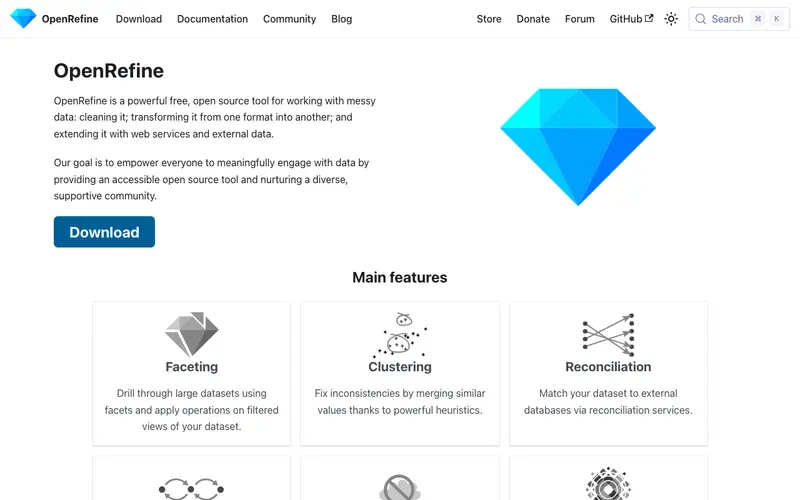
OpenRefine, originally developed by Google (as Google Refine) and now an open-source project, is a powerful desktop application for cleaning and transforming messy data. Its core feature allows users to 'facet' and 'cluster' data, identifying inconsistencies, duplicates, and errors across large datasets with intuitive graphical operations. It's primarily built for data journalists, researchers, librarians, data scientists, and anyone who frequently works with dirty or poorly structured data from various sources. Users typically open OpenRefine when they've acquired a dataset (e.g., from a government portal, survey, or spreadsheet) that requires significant cleaning before analysis or import into a database. It runs as a local web application accessible through a browser, compatible with Windows, macOS, and Linux, ensuring broad compatibility.
Editorial check
How this page is checked
Source trail
openrefine.org
External links are separated from Surfaced commentary.
Reader safety
Context before clicks
Product links and external services are not presented as guarantees.
Monetization
No affiliate flag
Ads and commerce links are kept distinct from editorial text.
Surfaced take
Why It’s Useful
While spreadsheet software can perform some data cleaning, OpenRefine excels at identifying patterns in messy data and applying transformations across thousands of rows with ease, far surpassing Excel for complex cleanup tasks. For the social science researcher preparing survey data, it can quickly standardize inconsistent text entries (e.g., 'NY', 'N.Y.', 'New York') and identify outliers in numerical fields, ensuring data quality. For the investigative journalist combining multiple public datasets, it efficiently reconciles differing formats and spellings, ensuring data integrity before analysis and preventing erroneous conclusions. It is completely free and open-source, maintained by a dedicated community, making it a reliable and cost-effective solution. A particularly potent but often overlooked feature is its 'Reconciliation' service, allowing users to match data against external databases like Wikidata or VIAF, enriching their datasets automatically. Its niche appeal and the fact it runs locally via a browser interface mean it's not as widely known as general data tools, despite its incredible power. It has a strong community, extensive documentation, and regular updates, ensuring continuous improvement and support.






Enjoyed this? Get five picks like this every morning.
Free daily newsletter — zero spam, unsubscribe anytime.