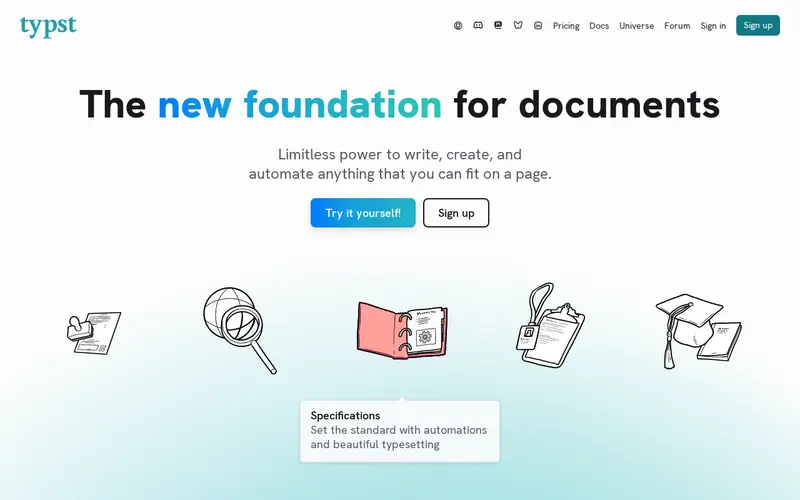
Typst is a powerful and modern typesetting system designed to create beautiful and complex documents with ease, offering a significant upgrade from traditional word processors and a more accessible alternative to LaTeX. It uses a simple, declarative syntax that is easy to learn and write, focusing on automation and reproducible results. Typst compiles documents very quickly and is well-suited for creating everything from simple letters to academic papers, books, and even code documentation. The system emphasizes extensibility through its own scripting language, allowing for custom templates and complex layouts.
Editorial check
How this page is checked
Source trail
typst.app
External links are separated from Surfaced commentary.
Reader safety
Context before clicks
Product links and external services are not presented as guarantees.
Monetization
No affiliate flag
Ads and commerce links are kept distinct from editorial text.
Surfaced take
Why It’s Useful
Typst is an exceptionally underrated tool for anyone serious about document creation, especially those who have struggled with the steep learning curve or clunky syntax of LaTeX. Its syntax is intuitive and clean, allowing for rapid prototyping and iteration of document designs. The blazing-fast compilation speed is a massive productivity boost compared to LaTeX, making it ideal for iterative writing and editing. Typst’s built-in features for intelligent layout, automatic cross-referencing, and bibliography management are robust and easy to implement. For example, generating a complex academic paper with intricate table of contents, figures, and references is significantly more streamlined. Its growing community and focus on modern design principles make it a compelling choice for academics, technical writers, and anyone who values the aesthetic and structural integrity of their documents.
In everyday life
When you’d actually reach for this
You might use Typst to create a polished personal budget report or to assemble a clear itinerary for a shared vacation. It's also helpful for generating professional-looking handouts for a club meeting or organizing those saved articles you intend to read.




Enjoyed this? Get five picks like this every morning.
Free daily newsletter — zero spam, unsubscribe anytime.