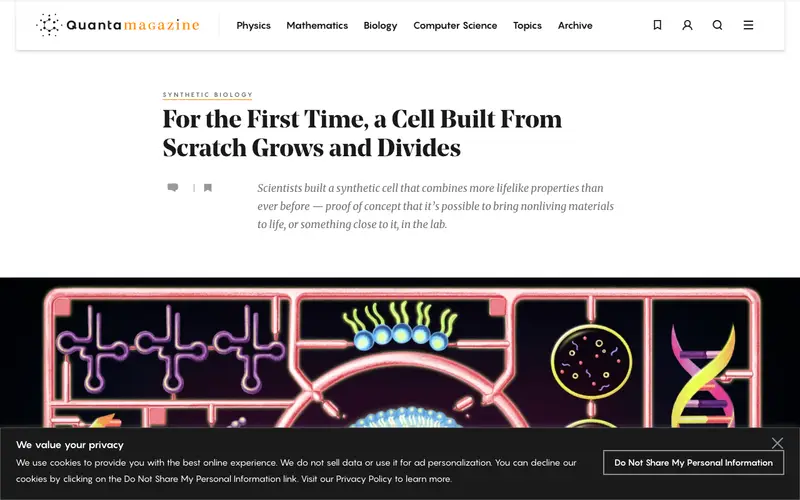
This article from Quanta Magazine reports on a groundbreaking scientific achievement: the creation of the first fully synthetic cell capable of autonomous growth and division. Researchers designed and built a minimal bacterial cell from the ground up, a significant step in synthetic biology. The work demonstrates the ability to engineer life's fundamental processes, opening doors for new approaches in medicine, materials science, and our understanding of life itself. It details the complex genetic and chemical engineering required to achieve this self-sustaining biological system.
Editorial check
How this page is checked
Source trail
quantamagazine.org
External links are separated from Surfaced commentary.
Reader safety
Context before clicks
Product links and external services are not presented as guarantees.
Monetization
No affiliate flag
Ads and commerce links are kept distinct from editorial text.
Surfaced take
Why It’s Useful
This article is a window into cutting-edge scientific research that is often hidden behind paywalls or inaccessible jargon. Quanta Magazine excels at translating complex scientific breakthroughs into understandable narratives. For those interested in biology, genetics, or the future of medicine, this offers profound insights into the potential of synthetic life. It highlights the iterative process of scientific discovery and the immense creativity involved in engineering biological systems. Its usefulness lies in providing a clear, authoritative account of a pivotal moment in life sciences, accessible to an educated lay audience.
In everyday life
When you’d actually reach for this
When you're trying to understand the latest science news you bookmarked, or when a friend asks about a complex biology topic they heard on a podcast, you might look for this. You could also use it if you're curious about the future possibilities of engineering living organisms.







Enjoyed this? Get five picks like this every morning.
Free daily newsletter — zero spam, unsubscribe anytime.