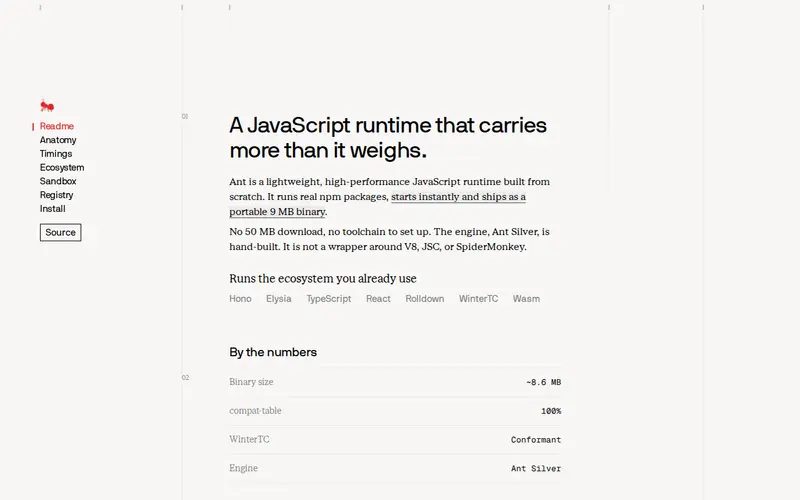
Ant is a contemporary JavaScript runtime and ecosystem built with server-side execution in mind. It presents an alternative architecture intended to surpass the performance benchmarks of established runtimes like Node.js. By integrating an optimized V8 engine and employing a novel architectural approach, Ant aims to minimize operational overhead and boost processing efficiency. The accompanying ecosystem comprises a selection of integrated tools and libraries, all designed to harmonize with the Ant runtime, thereby facilitating the creation of backend services that prioritize high performance.
Editorial check
How this page is checked
Source trail
antjs.org
External links are separated from Surfaced commentary.
Reader safety
Context before clicks
Product links and external services are not presented as guarantees.
Monetization
No affiliate flag
Ads and commerce links are kept distinct from editorial text.
Surfaced take
Why It’s Useful
For developers prioritizing maximum JavaScript performance on the server, Ant emerges as a noteworthy contender. Its design philosophy centers on a lean and highly efficient runtime, which can translate into substantial enhancements in application responsiveness and resource management, particularly for resource-intensive use cases such as robust APIs, scalable microservices, and demanding real-time data processing pipelines. While Node.js remains a dominant force, Ant offers a distinct architectural perspective with the potential to yield measurable gains for projects encountering performance limitations. Furthermore, its cohesive ecosystem is engineered to simplify the development workflow, making it an attractive option for teams where speed and backend architectural efficiency are paramount.
In everyday life
When you’d actually reach for this
You might use Ant when you need to quickly process a large batch of data for your personal finance tracker before payday. It's also useful for automating the organization of photos from your last vacation before you share them with friends.







Enjoyed this? Get five picks like this every morning.
Free daily newsletter — zero spam, unsubscribe anytime.