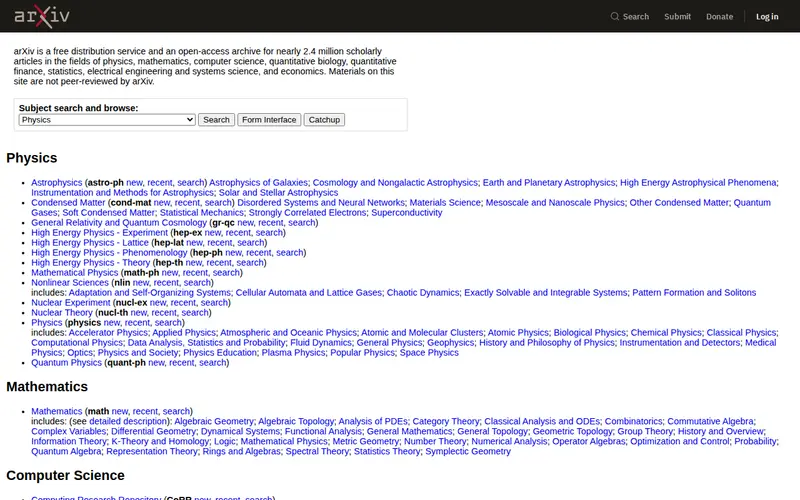
arXiv is a free, open-access repository of preprints for scientific research papers, primarily in physics, mathematics, computer science, quantitative biology, quantitative finance, statistics, electrical engineering and systems science, and economics. It allows researchers to share their work before formal peer review and publication, accelerating the dissemination of new findings. Users can browse, search, and download papers without any cost. It's a foundational platform for accessing cutting-edge research across many scientific disciplines.
Editorial check
How this page is checked
Source trail
arxiv.org
External links are separated from Surfaced commentary.
Reader safety
Context before clicks
Product links and external services are not presented as guarantees.
Monetization
No affiliate flag
Ads and commerce links are kept distinct from editorial text.
Surfaced take
Why It’s Useful
For anyone involved in science and technology, arXiv is an essential resource for staying at the forefront of their field. It provides immediate access to the latest research, often months or even years before it appears in traditional journals. This speed is critical for researchers who need to build upon the newest discoveries or identify emerging trends. The platform’s open-access model democratizes scientific knowledge, making cutting-edge research available to anyone with an internet connection, regardless of institutional affiliation or ability to pay journal subscription fees. It's a cornerstone for academic and industrial innovation.
In everyday life
When you’d actually reach for this
When a researcher in a rapidly evolving field wants to know the absolute latest discoveries in their specialty, they'll head to arXiv to find pre-publication papers that haven't yet hit traditional journals, giving them a critical head start.







Enjoyed this? Get five picks like this every morning.
Free daily newsletter — zero spam, unsubscribe anytime.