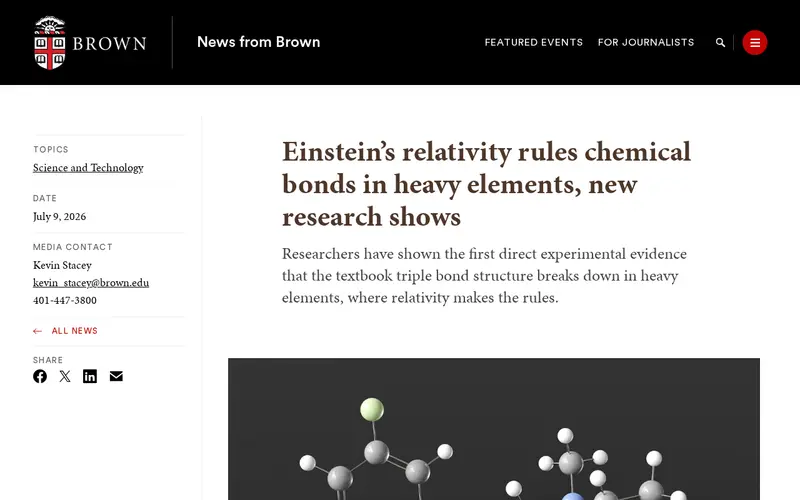
This research, published by Brown University, reveals how Einstein's theory of relativity plays a critical role in understanding the chemical behavior of heavy elements. It explains that as atoms become very heavy, their electrons move at speeds approaching the speed of light, necessitating relativistic calculations to accurately predict their bonding properties. This finding challenges previous assumptions and provides a more precise model for predicting the reactivity and characteristics of superheavy elements.
Editorial check
How this page is checked
Source trail
brown.edu
External links are separated from Surfaced commentary.
Reader safety
Context before clicks
Product links and external services are not presented as guarantees.
Monetization
No affiliate flag
Ads and commerce links are kept distinct from editorial text.
Surfaced take
Why It’s Useful
This is a fascinating dive into the counter-intuitive ways physics impacts chemistry at the extreme ends of the periodic table. For chemists, physicists, and material scientists, this research offers a crucial correction and refinement to their theoretical models, especially when dealing with elements beyond Uranium. It's useful because it provides a deeper, more accurate understanding of fundamental atomic interactions that can lead to breakthroughs in the synthesis and application of novel materials. Most people aren't aware that relativistic effects, usually associated with cosmology, have such a direct and significant impact on everyday chemistry, making this a profound, lesser-known scientific revelation.
In everyday life
When you’d actually reach for this
You're trying to understand why mercury is liquid at room temperature, or why gold is so inert. When you're curious about the unusual properties of elements that seem to defy simpler chemical rules, this information helps explain it.







Enjoyed this? Get five picks like this every morning.
Free daily newsletter — zero spam, unsubscribe anytime.