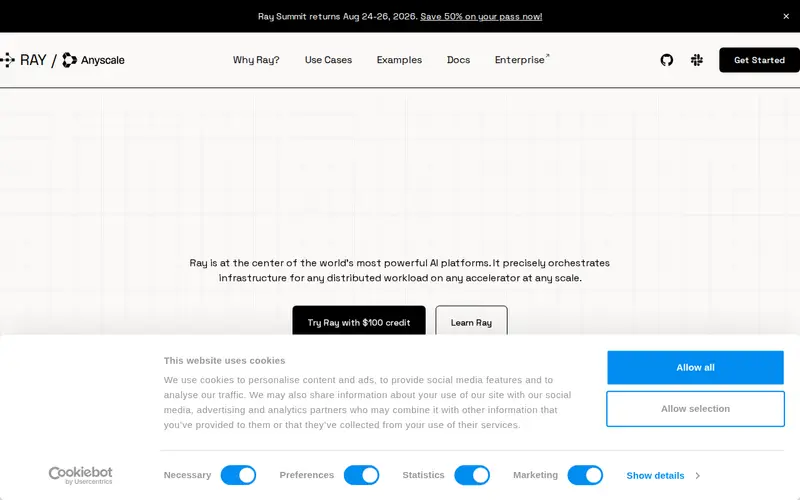
Ray is an open-source framework designed to simplify the scaling of Python applications, making it easier to build distributed applications and ML workloads. It provides a unified API for parallel and distributed execution, allowing developers to scale their code from a laptop to a large cluster without significant code changes. Ray is free and open-source, and it is particularly effective at handling complex, stateful distributed applications and machine learning tasks like hyperparameter tuning, reinforcement learning, and serving models.
Editorial check
How this page is checked
Source trail
ray.io
External links are separated from Surfaced commentary.
Reader safety
Context before clicks
Product links and external services are not presented as guarantees.
Monetization
No affiliate flag
Ads and commerce links are kept distinct from editorial text.
Surfaced take
Why It’s Useful
For data scientists and engineers working with large datasets or complex machine learning models, Ray is a game-changer. It abstracts away much of the complexity of distributed computing, allowing users to focus on their algorithms rather than the infrastructure. Ray's ability to scale Python code efficiently enables faster experimentation and quicker deployment of ML models in production. Its comprehensive ecosystem includes libraries for distributed training (Ray Train), hyperparameter tuning (Ray Tune), and reinforcement learning (RLlib), making it a one-stop shop for distributed AI. Developers seeking to build high-performance, scalable AI applications will find Ray invaluable.
In everyday life
When you’d actually reach for this
When you need to process a large dataset for your personal finance tracking or quickly analyze photos from a recent group trip. You might also use it to efficiently sort through a backlog of articles you've saved for later reading.







Enjoyed this? Get five picks like this every morning.
Free daily newsletter — zero spam, unsubscribe anytime.