Photo via Pexels
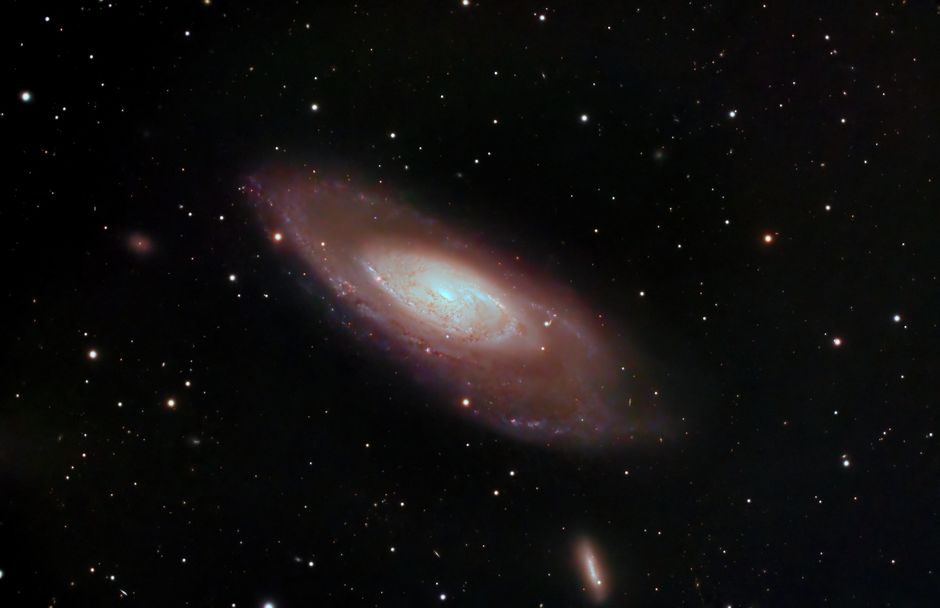
Astronomers have discovered a vast, ultra-diffuse galaxy, named NGC 1052-DF2, that is almost entirely devoid of dark matter. This discovery challenges fundamental assumptions about galaxy formation and the distribution of this mysterious substance. The galaxy's peculiar lack of dark matter was identified by researchers led by Pieter van Dokkum of Yale University, and the findings were published in the journal Nature in March 2018. The absence of dark matter in such a massive structure has left cosmologists scrambling to explain how it formed and remains gravitationally bound.
Editorial check
How this page is checked
Source trail
nature.com
External links are separated from Surfaced commentary.
Reader safety
Context before clicks
Product links and external services are not presented as guarantees.
Monetization
No affiliate flag
Ads and commerce links are kept distinct from editorial text.
Surfaced take
Why It’s Fascinating
The existence of NGC 1052-DF2, a galaxy roughly the size of the Milky Way but with about 200 times fewer stars, is profoundly surprising because our current cosmological models strongly predict that all large galaxies should be embedded within massive halos of dark matter. Dark matter is the invisible scaffolding that is thought to hold galaxies together, influencing their rotation curves and overall structure. Its apparent absence in NGC 1052-DF2 suggests that either our understanding of dark matter is incomplete, or there are entirely new mechanisms at play that allow galaxies to form and exist without it. This finding could force a re-evaluation of the Lambda-CDM model, the prevailing framework for understanding the universe's evolution. The implications are far-reaching: if galaxies can form without significant dark matter, it might mean that the seeds of structure in the early universe were planted differently than we believed. One pressing question is whether other such 'dark matter-deficient' galaxies exist, waiting to be discovered and further upending our cosmic census.
Related

The bottleneck might be the air in the room
This article delves into the often-overlooked impact of indoor air quality, specifically carbon dioxide (CO2) levels, on human cognitive function and…

devspace
DevSpace is an innovative open-source tool that bridges the gap between natural language and code generation by transforming large language models like ChatGPT…
Enjoyed this? Get five picks like this every morning.
Free daily newsletter — zero spam, unsubscribe anytime.