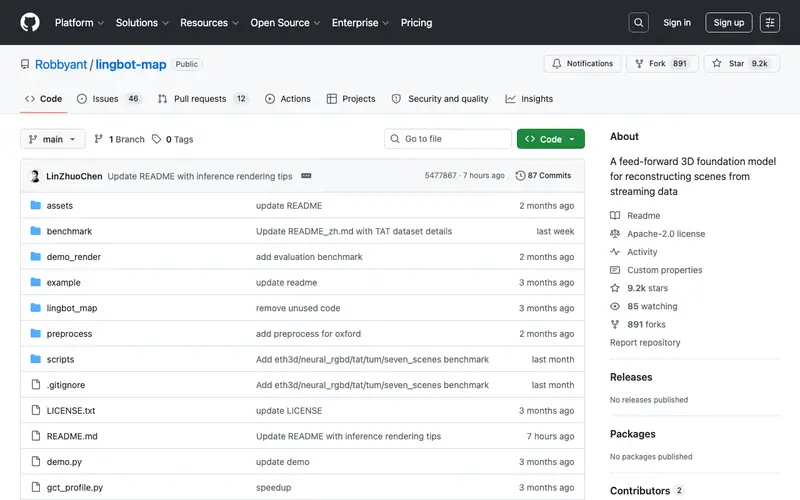
lingbot-map is a sophisticated feed-forward 3D foundation model designed for reconstructing complex scenes from streaming data. It excels at taking continuous inputs, such as from sensors or video feeds, and building a coherent, three-dimensional representation of the environment in real-time. This Python-based project focuses on efficiency and accuracy, making it suitable for applications in robotics, augmented reality, and autonomous systems where understanding spatial context is paramount. The project is open-source, promoting accessibility and further development.
Editorial check
How this page is checked
Source trail
github.com
External links are separated from Surfaced commentary.
Reader safety
Context before clicks
Product links and external services are not presented as guarantees.
Monetization
No affiliate flag
Ads and commerce links are kept distinct from editorial text.
Surfaced take
Why It’s Useful
For anyone working with spatial computing, robotics, or advanced sensor data, lingbot-map offers a powerful and efficient solution for real-time 3D scene understanding. Its ability to process streaming data means it can continuously update its understanding of an environment, which is critical for dynamic situations like a robot navigating a moving space or an AR application overlaying virtual objects onto a changing real world. The 'foundation model' aspect suggests it can be adapted and fine-tuned for specific tasks, offering a versatile starting point. The high star count on GitHub (over 6,000) reflects its significant impact and interest within the computer vision and robotics communities. It allows for the creation of more intelligent and context-aware AI systems.
In everyday life
When you’d actually reach for this
You might use it to quickly map out a new hiking trail from your phone's GPS data to share with friends. Or, if you're setting up a home security system, you could use it to create a real-time 3D model of your property.







Enjoyed this? Get five picks like this every morning.
Free daily newsletter — zero spam, unsubscribe anytime.