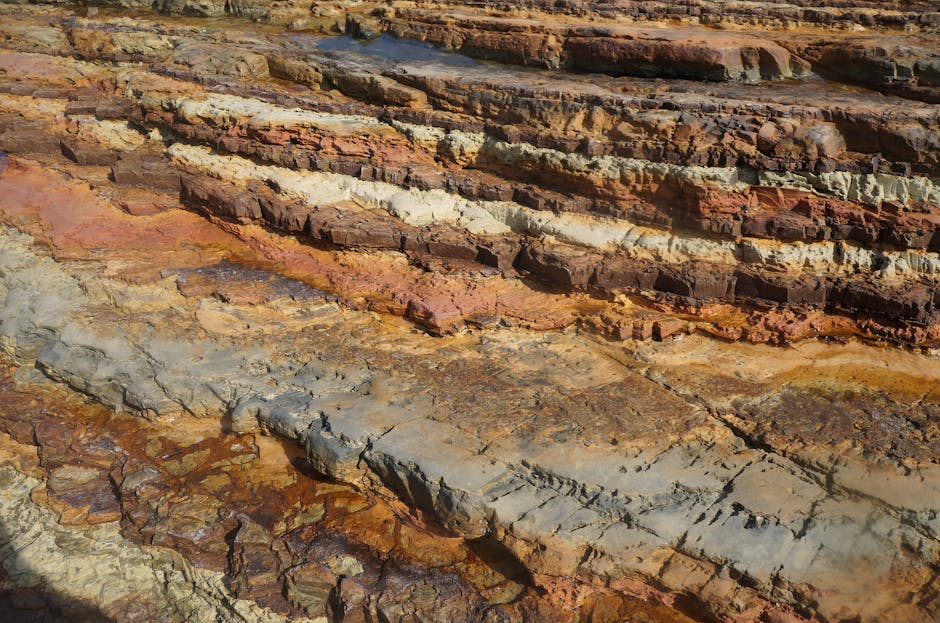
Photo via Pexels
In 2023, seismologists Hrvoje Tkalčić and Thanh-Son Pham from the University of California, Berkeley, published research in 'Nature Geoscience' suggesting Earth's innermost solid iron ball might not be a single uniform entity. By analyzing seismic waves that travel through the Earth's core, they identified a subtle, previously undetected structure. This discovery implies a more complex and dynamic history for our planet's deep interior than previously understood.
Why It’s Fascinating
For decades, Earth's inner core was understood as a single, solid sphere of iron and nickel, frozen by immense pressure. This new finding, based on analyzing seismic wave patterns that bounce back from the inner core at specific angles, reveals a distinct textural difference within the innermost 1,300 kilometers. The researchers observed that seismic waves traveling parallel to the Earth's rotation axis show different speeds and amplitudes than those traveling at an angle. This suggests a change in the crystal structure or alignment of iron atoms, potentially indicating a separate, inner solid layer formed earlier in Earth's history. This challenges our models of planetary formation and the processes that govern the geodynamo, which generates Earth's magnetic field. The implications for understanding planetary evolution, magnetic field stability, and even the habitability of other planets are profound. It raises the question: what primordial conditions led to the formation of this double-layered heart of our planet, and are similar structures found at the core of other rocky worlds?
More Like This

Your Body Hosts More Bacterial Cells Than Human Cells
Recent research suggests that the number of bacterial cells living within and on your body vastly outnumbers your own human cells, though the ratio is closer than previously thought. These microscopic residents, collectively known as the microbiome, play crucial roles in digestion, immunity, and even mental health.

Your Body Emits a Faint, Continuous Light That's Invisible to Our Eyes
Despite appearing dark, the human body constantly emits a faint amount of visible light, a phenomenon known as biophoton emission. This glow is thousands of times weaker than what our eyes can detect, but advanced sensitive cameras have captured it, often peaking in the late afternoon.

Earth's Great Oxygenation Event: The Ancient Ecological Revolution
Around 2.4 billion years ago, Earth experienced the Great Oxygenation Event, a period when photosynthetic organisms began producing oxygen in vast quantities. This oxygen accumulated in the atmosphere and oceans, fundamentally changing the planet's chemistry. It was a planetary-scale ecological catastrophe for anaerobic life, but paved the way for oxygen-breathing organisms.

Deep-Sea Hydrothermal Vents: Life Thrives Without Sunlight Through Chemosynthesis
Discovered in 1977, hydrothermal vents are fissures on the seafloor that spew superheated, mineral-rich water, creating unique ecosystems in the abyssal depths. These environments host bizarre life forms, from giant tube worms to unique species of shrimp, that thrive in perpetual darkness.
Explore Related
From Product, Hidden Gem, Future Tech, Tool

Anker 737 Power Bank (PowerCore 24K Hi-Fi)
The Anker 737 Power Bank is a high-capacity portable charger designed for power users and travelers. With a 24,000mAh capacity and 140W total output, it can simultaneously charge multiple devices, including laptops, tablets, and smartphones, at rapid speeds. Its standout feature is the smart digital display that shows power output, input, and estimated recharge time, offering unprecedented transparency into its charging status.

Excalidraw
Excalidraw is a virtual whiteboard that enables users to quickly sketch diagrams, wireframes, and other visual concepts with a distinct hand-drawn aesthetic. It's open-source, collaborative, and perfect for brainstorming sessions.

Direct Brain-to-Brain Communication Interfaces
This technology aims to enable direct transfer of thoughts, emotions, and memories between human brains without external sensory input. It would involve advanced neural decoding and encoding techniques, potentially using focused electromagnetic fields or optogenetics to bridge neural activity.

Krita
Krita is a free and open-source raster graphics editor designed primarily for digital painting, 2D animation, and comics creation. It offers a comprehensive set of brushes, layers, vector tools, and artistic filters, making it suitable for both professional artists and hobbyists.
You Might Also Like

Ancient Roman Concrete Had Self-Healing Properties
Explore →
Synthetic Cells Demonstrate Biological Evolution in Lab
Explore →
Ancient Hominin Diet Revealed by Fossil Teeth
Explore →
Venus's Ancient Past May Have Harbored Oceans
Explore →
Ancient Farmers Cultivated Insects
Explore →
Deep-Sea Vents Host Astonishing New Life Forms
Explore →Ancient Roman Concrete Had Self-Healing Properties
Explore →Synthetic Cells Demonstrate Biological Evolution in Lab
Explore →Ancient Hominin Diet Revealed by Fossil Teeth
Explore →Venus's Ancient Past May Have Harbored Oceans
Explore →Ancient Farmers Cultivated Insects
Explore →Deep-Sea Vents Host Astonishing New Life Forms
Explore →Enjoyed this? Get five picks like this every morning.
Free daily newsletter — zero spam, unsubscribe anytime.