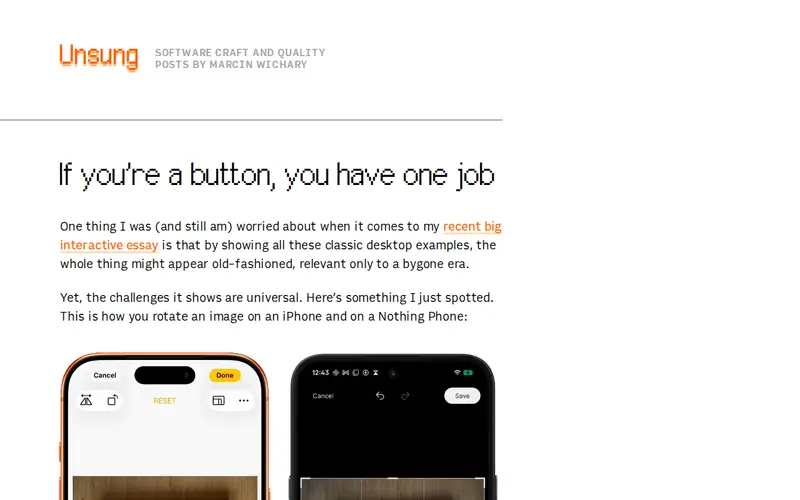
This is a captivating and thought-provoking exploration of the fundamental nature of user interface elements, specifically buttons. It delves into the core responsibility of a button: to trigger an action. The article uses a minimalist approach to dissect what it means for a digital button to fulfill its purpose, considering its state, feedback, and the user's expectation. It's a piece that makes you reconsider the simplicity and complexity of everyday digital interactions. For instance, a web designer might use the principles discussed here to ensure their call-to-action buttons are unambiguous and provide clear feedback upon click, thereby improving user experience and conversion rates.
Editorial check
How this page is checked
Source trail
unsung.aresluna.org
External links are separated from Surfaced commentary.
Reader safety
Context before clicks
Product links and external services are not presented as guarantees.
Monetization
No affiliate flag
Ads and commerce links are kept distinct from editorial text.
Surfaced take
Why It’s Useful
This article is a valuable, albeit conceptually driven, resource for anyone involved in UI/UX design or frontend development. It offers a philosophical yet practical lens through which to view interactive elements, pushing developers and designers beyond just making things look good to ensuring they function with absolute clarity. Its value lies in its ability to reframe a basic UI component, prompting deeper consideration of user intent and system response. Unlike standard UI guides, it encourages a more principled approach to design. Power users, especially those building robust and intuitive applications, will appreciate the emphasis on the 'single job' principle for buttons, which helps prevent feature creep and maintains a clean, predictable interface. It’s particularly useful for developers who want to build highly responsive and user-friendly interfaces where every interaction feels deliberate and correct.
In everyday life
When you’d actually reach for this
When you're trying to finalize a weekend project, or perhaps when you're setting up a shared document for a family vacation. You might also use it when reviewing a colleague's code before you go on holiday.






Enjoyed this? Get five picks like this every morning.
Free daily newsletter — zero spam, unsubscribe anytime.