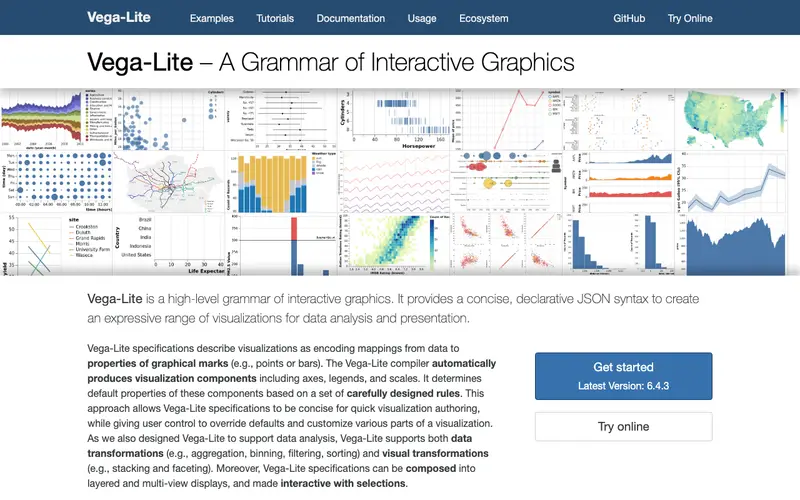
Vega-Lite is a high-level grammar for interactive graphics, developed by the University of Washington Interactive Data Lab, which provides a concise JSON syntax for creating a wide range of common statistical graphics. Its core feature is a declarative approach where users describe *what* they want to visualize, rather than *how* to draw it pixel by pixel, allowing for rapid prototyping and powerful interactivity. This tool is primarily built for data scientists, researchers, and developers who need fine-grained control over their visualizations but want to avoid the complexity of low-level libraries like D3.js. Someone would use Vega-Lite when they have structured data and need to generate precise, custom charts programmatically, often for web applications or scientific papers. It integrates well with various programming languages (e.g., Python with Altair, JavaScript) and can render to SVG or Canvas.
Editorial check
How this page is checked
Source trail
vega.github.io
External links are separated from Surfaced commentary.
Reader safety
Context before clicks
Product links and external services are not presented as guarantees.
Monetization
No affiliate flag
Ads and commerce links are kept distinct from editorial text.
Surfaced take
Why It’s Useful
While charting libraries like Chart.js offer pre-built components, Vega-Lite provides a declarative "grammar of graphics" that offers far more expressive power and customizability, making it superior for complex statistical visualizations. For the data scientist exploring experimental results, Vega-Lite allows them to quickly generate a custom scatter plot with interactive filters and tooltips directly from their Python script. A web developer building an analytics dashboard can use it to create unique, responsive charts that perfectly fit their application's design language, all defined in concise JSON. Vega-Lite is completely free and open-source, supported by academic research. A powerful feature often overlooked is its "concatenation" and "layering" capabilities, allowing users to combine multiple independent charts or overlay different graphical elements with ease. Its declarative, JSON-based syntax requires a certain level of technical comfort, limiting its appeal to non-programmers despite its elegance. The project is backed by active academic research, has an extensive gallery of examples, and sees continuous development.
In everyday life
When you’d actually reach for this
You're trying to understand your monthly spending habits and want to see where your money went last quarter. Or perhaps you're planning a group trip and need to visualize everyone's budget contributions before you book anything. You might also use it to quickly generate a simple chart for a colleague before you hand off a project.







Enjoyed this? Get five picks like this every morning.
Free daily newsletter — zero spam, unsubscribe anytime.