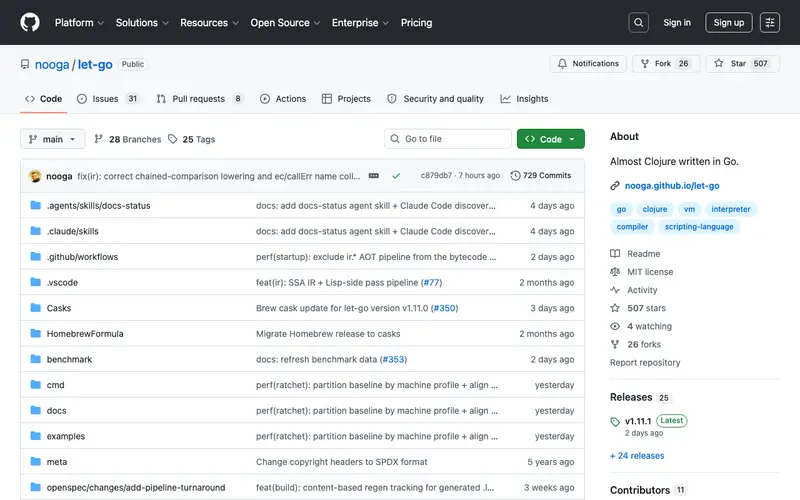
let-go is a fascinating project that implements a Clojure-like programming language entirely in Go. The primary goal is to achieve exceptionally fast startup times, boasting boots in as little as 7 milliseconds. It offers functional programming paradigms inspired by Clojure, such as immutability and first-class functions, but within the Go ecosystem. This makes it suitable for developers who appreciate functional approaches and need rapid execution for certain types of applications, like scripting or embedded systems where quick initialization is paramount.
Editorial check
How this page is checked
Source trail
github.com
External links are separated from Surfaced commentary.
Reader safety
Context before clicks
Product links and external services are not presented as guarantees.
Monetization
No affiliate flag
Ads and commerce links are kept distinct from editorial text.
Surfaced take
Why It’s Useful
This project is a hidden gem for developers interested in exploring language design and performance optimization without abandoning the familiar Go environment. While Clojure is known for its JVM strengths, let-go brings a similar expressive, functional style to Go's efficient compilation and deployment. Its standout feature is the incredibly low boot time, making it an attractive option for tasks that require instant startup, such as command-line tools or serverless functions. It's a proof of concept that demonstrates the power of language implementation and how familiar paradigms can be adapted to different runtime environments, appealing to language enthusiasts and performance-critical developers alike.
In everyday life
When you’d actually reach for this
You need to quickly spin up a small script to automate a repetitive task, like renaming a batch of photos. Or perhaps you're building a small, internal tool for your team that needs to start instantly every time it's used.







Enjoyed this? Get five picks like this every morning.
Free daily newsletter — zero spam, unsubscribe anytime.