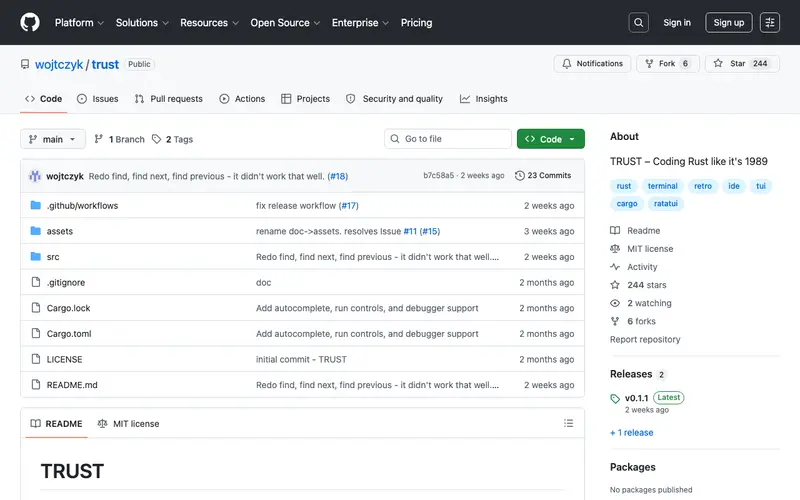
TRUST is an experimental project that aims to make coding Rust feel like programming in the late 1980s, reminiscent of languages like C. It achieves this by imposing certain constraints and offering a different syntax and development experience compared to modern Rust. The project focuses on low-level control and a more direct interaction with hardware, stripping away some of Rust's higher-level abstractions. This is an exploration into retro-computing aesthetics and programming styles within a contemporary language.
Editorial check
How this page is checked
Source trail
github.com
External links are separated from Surfaced commentary.
Reader safety
Context before clicks
Product links and external services are not presented as guarantees.
Monetization
No affiliate flag
Ads and commerce links are kept distinct from editorial text.
Surfaced take
Why It’s Useful
For developers who have a nostalgic inclination towards older programming paradigms or who need to understand systems programming at a more fundamental level, TRUST offers a unique perspective. It's an educational tool that challenges conventional Rust development by reintroducing concepts and a feel from a bygone era. While not intended for mainstream production use, it allows programmers to experiment with the underlying mechanics of Rust in a way that might be obscured by its modern features. This project is particularly valuable for those interested in systems programming history, embedded development, or simply exploring different ways to interact with a powerful language like Rust.
In everyday life
When you’d actually reach for this
You might reach for TRUST when you need to understand exactly how a small embedded system is behaving without the distractions of modern abstractions. It's for those times you're debugging a performance-critical loop in a legacy system and want a more direct, C-like feel to your Rust code.





Enjoyed this? Get five picks like this every morning.
Free daily newsletter — zero spam, unsubscribe anytime.