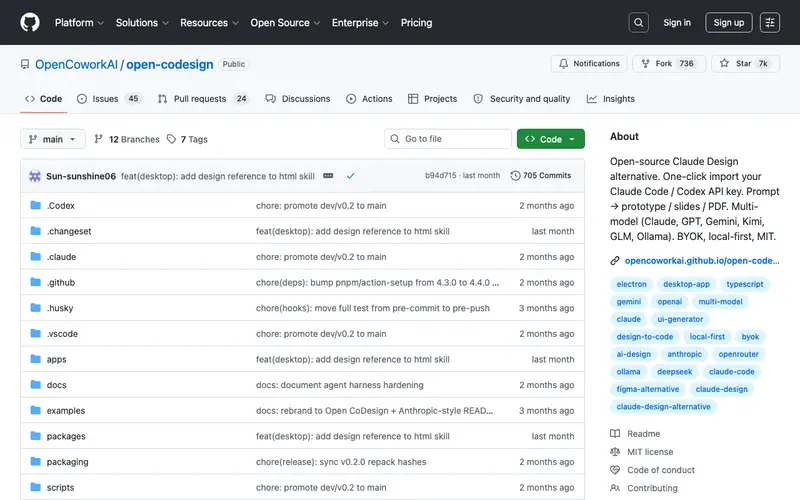
Open-codesign is an open-source alternative to proprietary AI design tools, designed to convert prompts into interactive prototypes, slides, and PDFs. It offers a one-click import for your Claude Code or Codex API key, allowing seamless integration with powerful AI models. Supporting a multi-model approach, it works with Claude, GPT, Gemini, Kimi, GLM, and Ollama. The platform emphasizes Bring Your Own Key (BYOK) and local-first functionality for enhanced privacy and control, making it a versatile and secure option for prompt-based design generation.
Editorial check
How this page is checked
Source trail
github.com
External links are separated from Surfaced commentary.
Reader safety
Context before clicks
Product links and external services are not presented as guarantees.
Monetization
No affiliate flag
Ads and commerce links are kept distinct from editorial text.
Surfaced take
Why It’s Useful
Open-codesign empowers users to transform their ideas into visual designs with unprecedented ease, leveraging the power of multiple leading AI models. Its ability to generate prototypes, presentations, and PDFs directly from textual prompts dramatically accelerates the design iteration cycle. For individuals and teams who rely on rapid prototyping and visual communication, this tool is a game-changer. The support for various AI models offers flexibility, while the BYOK and local-first approach ensures data privacy and security, which is crucial in professional settings. It’s particularly beneficial for those who want to experiment with different AI engines without being locked into a single ecosystem, and for users who prioritize having more control over their design generation process.
In everyday life
When you’d actually reach for this
Need to quickly visualize a presentation for a client meeting tomorrow morning? Or perhaps you want to sketch out a user flow for a new app idea you had last night before you forget it.







Enjoyed this? Get five picks like this every morning.
Free daily newsletter — zero spam, unsubscribe anytime.