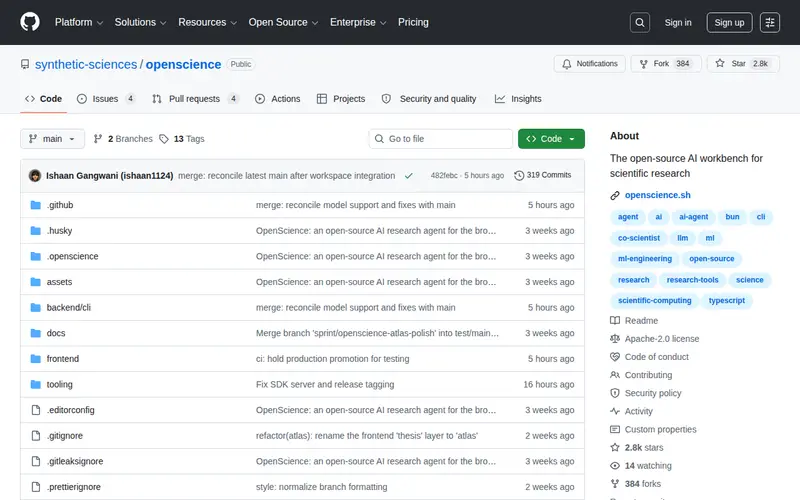
openscience is an open-source AI workbench designed to accelerate scientific research. It provides a collaborative platform for data scientists, researchers, and developers to build, train, and deploy AI models. The tool streamlines the complex process of AI development by offering modular components for data handling, model experimentation, and deployment. It is completely free and open-source, making advanced AI research accessible. A key feature is its ability to manage diverse datasets and computational resources efficiently, facilitating reproducible scientific findings.
Editorial check
How this page is checked
Source trail
github.com
External links are separated from Surfaced commentary.
Reader safety
Context before clicks
Product links and external services are not presented as guarantees.
Monetization
No affiliate flag
Ads and commerce links are kept distinct from editorial text.
Surfaced take
Why It’s Useful
This tool is invaluable for anyone involved in AI-driven scientific discovery, significantly reducing the time and effort required for AI model development. Its modular architecture allows for easy customization and integration with existing research pipelines. By fostering collaboration through its open-source nature, openscience promotes knowledge sharing and innovation within the scientific community. Users can leverage pre-built components, saving them from reinventing the wheel for common AI tasks. The platform is particularly beneficial for academic institutions and smaller research groups that may lack extensive proprietary AI infrastructure. It enables faster iteration on hypotheses and quicker translation of research into actionable insights, making it a cornerstone for modern scientific advancement.
In everyday life
When you’d actually reach for this
When you need to quickly test a new idea for analyzing your personal finance data or want to share a complex research project with colleagues before going on vacation, openscience helps you get there. You can also use it to organize and run through those saved articles you've been meaning to dive into.







Enjoyed this? Get five picks like this every morning.
Free daily newsletter — zero spam, unsubscribe anytime.