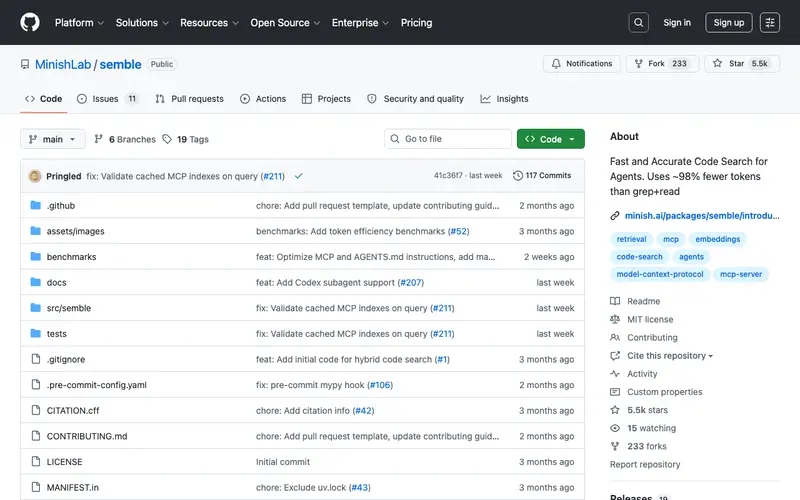
Semble is a powerful code search engine specifically designed for AI agents and developers working with large codebases. It achieves remarkable efficiency by utilizing only 2% of the tokens typically consumed by traditional tools like `grep`, making it significantly faster and more cost-effective for AI-driven code analysis. This tool is built by MinishLab and is ideal for scenarios where an AI needs to quickly navigate and understand complex code structures without incurring massive processing costs.
Editorial check
How this page is checked
Source trail
github.com
External links are separated from Surfaced commentary.
Reader safety
Context before clicks
Product links and external services are not presented as guarantees.
Monetization
No affiliate flag
Ads and commerce links are kept distinct from editorial text.
Surfaced take
Why It’s Useful
In the burgeoning field of AI code assistance, efficient code comprehension is paramount. Semble addresses this by offering a token-optimized search, a critical advantage when AI models are constrained by token limits or when dealing with computationally expensive operations. For instance, an AI agent tasked with refactoring a large project could use Semble to rapidly identify all instances of a specific function signature or a particular library import, a process that would be prohibitively slow and costly with conventional tools. Its focus on agents makes it a forward-thinking solution for developers building next-generation AI development workflows, saving valuable time and resources.
In everyday life
When you’d actually reach for this
You're trying to quickly find a specific function across your company's vast internal documentation before a client call. Or perhaps you're sifting through a coworker's messy project before they go on vacation, needing to grasp the core logic without drowning in details.







Enjoyed this? Get five picks like this every morning.
Free daily newsletter — zero spam, unsubscribe anytime.