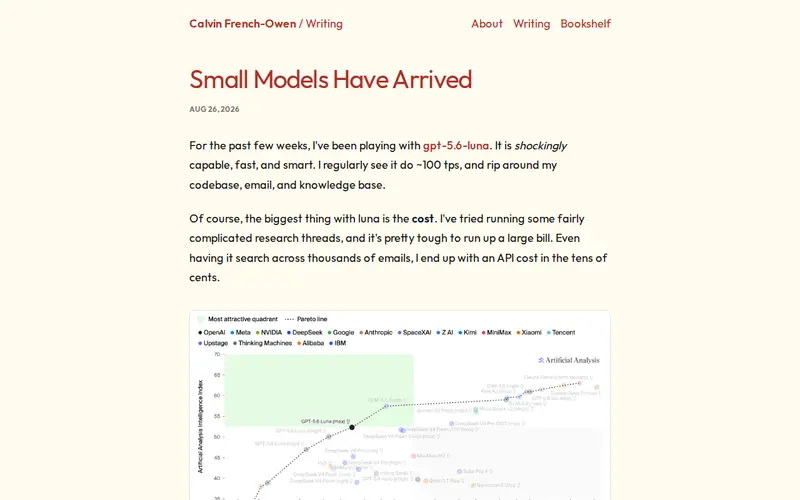
Calvin's article, 'Small Models Have Arrived,' discusses the recent surge and effectiveness of smaller, more efficient AI models. It argues that while large language models (LLMs) have dominated headlines, significant advancements are being made in creating models that are not only smaller but also highly capable, often rivaling their larger counterparts in specific tasks. The piece explores the implications of this trend for accessibility, deployment, and the democratization of AI technology. It's essential reading for anyone tracking the evolution of AI beyond just the biggest names.
Editorial check
How this page is checked
Source trail
calv.info
External links are separated from Surfaced commentary.
Reader safety
Context before clicks
Product links and external services are not presented as guarantees.
Monetization
No affiliate flag
Ads and commerce links are kept distinct from editorial text.
Surfaced take
Why It’s Useful
This article is crucial for demystifying the AI landscape, which often feels dominated by immense, resource-intensive models. It highlights the power and practicality of smaller models, making advanced AI more accessible for developers and researchers with limited budgets or hardware. Its usefulness lies in shifting the focus from sheer size to intelligent design and specialized capabilities. For those who feel intimidated by the scale of LLMs, this provides an encouraging and informative perspective on a parallel, equally important, thread of AI development.
In everyday life
When you’d actually reach for this
You might read this to understand why AI tools are starting to feel more responsive on your devices, or to learn about new, more efficient AI applications becoming available.







Enjoyed this? Get five picks like this every morning.
Free daily newsletter — zero spam, unsubscribe anytime.