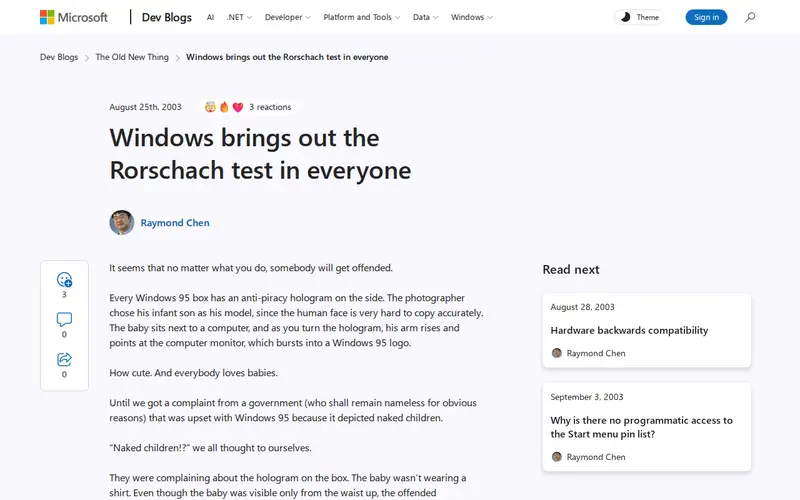
This article from Microsoft's 'The Old New Thing' blog delves into the psychological impact of Windows' user interface design choices, specifically referencing the perceived 'look' of the windows themselves and how users interpret them. It humorously explores how different individuals see distinct patterns or 'faces' in the windows, akin to a Rorschach test, and discusses the implications for UI designers in creating universally understood interfaces.
Editorial check
How this page is checked
Source trail
devblogs.microsoft.com
External links are separated from Surfaced commentary.
Reader safety
Context before clicks
Product links and external services are not presented as guarantees.
Monetization
No affiliate flag
Ads and commerce links are kept distinct from editorial text.
Surfaced take
Why It’s Useful
This piece is a delightful and insightful read for anyone involved in software design or user experience. It highlights a often-overlooked aspect of UI: the subconscious perception users have of visual elements. The author, Raymond Chen, is a legendary figure in Windows development, and his ability to connect technical details with human psychology is exceptional. It's a reminder that good design goes beyond mere functionality and taps into how people naturally interpret visual stimuli. Developers and designers who appreciate the subtle art of interface creation will find this perspective enlightening.
In everyday life
When you’d actually reach for this
While designing a new application interface, you consider how users might perceive the visual elements, recalling this article about how even simple window frames can evoke unconscious interpretations and aiming for clarity.






Enjoyed this? Get five picks like this every morning.
Free daily newsletter — zero spam, unsubscribe anytime.