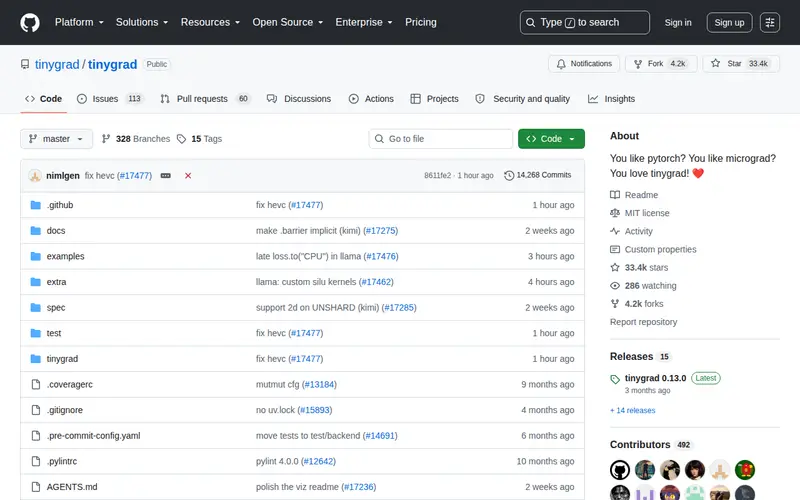
tinygrad is a minimalist deep learning framework designed for simplicity and ease of understanding, aiming to be a more accessible alternative to larger, more complex frameworks like PyTorch or TensorFlow. It focuses on providing core functionalities with a clean, readable codebase, written primarily in Python. tinygrad is open-source and free to use, making it an excellent tool for learning about machine learning internals or for researchers and developers who need a lightweight and transparent framework for experimentation. It aims to offer a fast, flexible, and efficient path to building and training neural networks.
Editorial check
How this page is checked
Source trail
github.com
External links are separated from Surfaced commentary.
Reader safety
Context before clicks
Product links and external services are not presented as guarantees.
Monetization
No affiliate flag
Ads and commerce links are kept distinct from editorial text.
Surfaced take
Why It’s Useful
For developers and researchers interested in the inner workings of machine learning, tinygrad offers an unparalleled entry point. Its deliberately uncluttered design makes it significantly easier to grasp the fundamental concepts of automatic differentiation, tensor operations, and neural network architectures compared to more feature-rich, but also more opaque, frameworks. This clarity allows users to experiment with novel ideas or debug complex issues with greater confidence. Despite its simplicity, tinygrad is capable of training state-of-the-art models and runs efficiently on various hardware, including CPUs and GPUs. It's a fantastic resource for educational purposes, rapid prototyping of new ML algorithms, and for those who value transparency and control in their development process.
In everyday life
When you’d actually reach for this
When you're trying to understand the fundamental concepts behind neural networks without getting bogged down in boilerplate code, you might reach for tinygrad. If you're a student or hobbyist wanting to experiment with a small, self-contained deep learning project, this tool could be useful.







Enjoyed this? Get five picks like this every morning.
Free daily newsletter — zero spam, unsubscribe anytime.