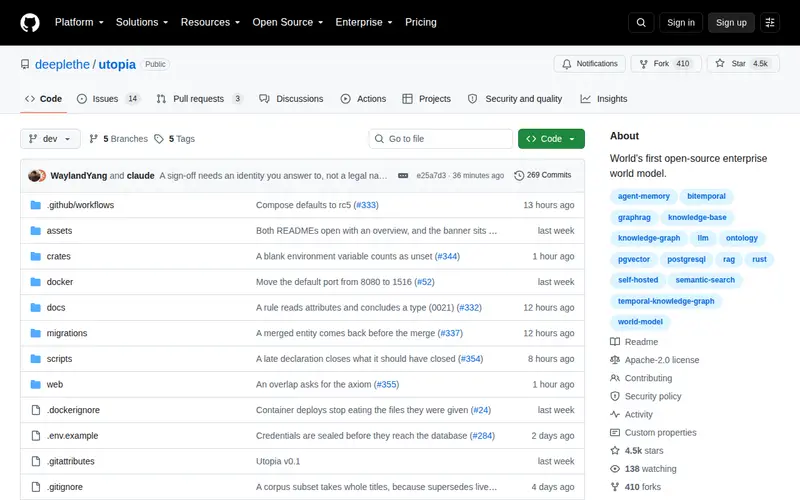
Utopia presents itself as the inaugural open-source enterprise world model, built with the Rust programming language. Its core objective is to establish a robust, extensible framework for simulating and interpreting multifaceted global systems. The project prioritizes transparency and flexibility, aiming to equip organizations with the capability to construct intricate models that represent the interwoven dynamics of economic, social, and environmental elements. By embracing an open-source methodology, Utopia fosters collaborative development and enables users to tailor the model extensively to their specific requirements.
Editorial check
How this page is checked
Source trail
github.com
External links are separated from Surfaced commentary.
Reader safety
Context before clicks
Product links and external services are not presented as guarantees.
Monetization
No affiliate flag
Ads and commerce links are kept distinct from editorial text.
Surfaced take
Why It’s Useful
Navigating the complexities of today's interconnected global landscape necessitates precise tools for insightful analysis. Utopia provides a potent, open-source alternative to proprietary modeling software, empowering enterprises to develop sophisticated simulations with greater autonomy. The utilization of Rust indicates a commitment to high performance and dependable operation, essential for rigorous analytical endeavors. Furthermore, its open-source foundation ensures ongoing development driven by a community of users, promising a continuously evolving set of functionalities and practical applications for diverse strategic planning and problem-solving scenarios.
In everyday life
When you’d actually reach for this
When planning long-term business strategies or assessing the potential impact of global events, a tool like Utopia could help visualize complex scenarios. It would allow decision-makers to explore 'what-if' situations by modeling economic shifts, supply chain disruptions, or environmental changes to inform more robust planning.






Enjoyed this? Get five picks like this every morning.
Free daily newsletter — zero spam, unsubscribe anytime.