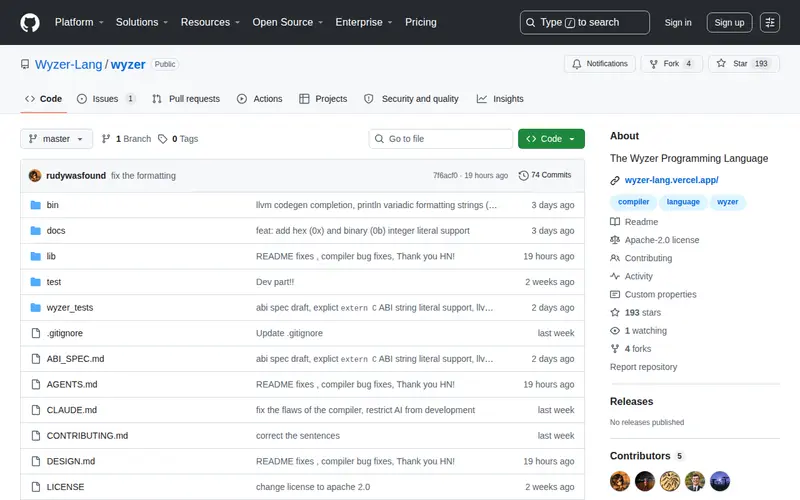
Wyzer is a statically-typed, functional programming language engineered for the creation of dependable and easily maintainable applications. It champions core functional programming principles, including immutability, sophisticated pattern matching, and algebraic data types, with the explicit goal of minimizing common programming pitfalls and enhancing code readability. The language is compiled, which allows for performance characteristics competitive with established low-level languages, and it is designed to be portable across a range of computing platforms. Wyzer is developed by a community of programmers seeking a more expressive and secure environment for software development.
Editorial check
How this page is checked
Source trail
github.com
External links are separated from Surfaced commentary.
Reader safety
Context before clicks
Product links and external services are not presented as guarantees.
Monetization
No affiliate flag
Ads and commerce links are kept distinct from editorial text.
Surfaced take
Why It’s Useful
In the current programming language ecosystem, Wyzer provides a distinctive approach for developers aiming for a more functional and inherently safer coding process. Its robust type system and emphasis on immutability contribute to a notable reduction in software defects, particularly within concurrent or intricate system architectures. Developers who are drawn to languages such as Haskell or OCaml but are looking for more contemporary syntax and improved tooling will find Wyzer to be a significant contender. It is especially well-suited for individuals ready to embrace new programming paradigms to boost their efficiency and the overall robustness of their software projects.
In everyday life
When you’d actually reach for this
You might use Wyzer when you're building a small utility to track your personal finances, or when you need to create a script to organize those dozens of browser tabs you've saved. It's also a good choice if you're handing off a project before going on vacation and want to ensure your colleague can easily understand and maintain the code.






Enjoyed this? Get five picks like this every morning.
Free daily newsletter — zero spam, unsubscribe anytime.