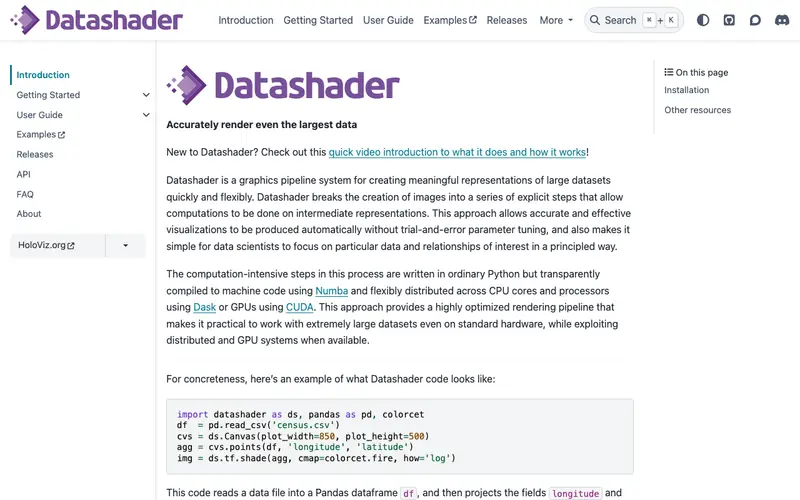
Datashader is an open-source Python library developed by Anaconda, designed for quickly and accurately rendering large datasets as images. Its core feature is downsampling massive amounts of data (billions of points or more) into fixed-size raster graphics, enabling visualization without overwhelming memory or CPU, even on standard hardware. It is primarily built for data scientists, analysts, and researchers working with extremely large datasets that traditional plotting libraries struggle to handle. Users typically open Datashader when they need to explore the overall structure and patterns within a huge dataset, often a scatter plot or spatial distribution, before diving into smaller subsets. It integrates seamlessly with popular Python libraries like Pandas, Dask, Bokeh, and HoloViews, and is particularly powerful for geospatial and time-series data.
Editorial check
How this page is checked
Source trail
datashader.org
External links are separated from Surfaced commentary.
Reader safety
Context before clicks
Product links and external services are not presented as guarantees.
Monetization
No affiliate flag
Ads and commerce links are kept distinct from editorial text.
Surfaced take
Why It’s Useful
While mainstream libraries like Matplotlib or Plotly can visualize data, Datashader is superior for handling truly *big* data, preventing overplotting and revealing underlying densities and patterns that would be lost in a traditional plot. For the financial analyst examining millions of stock trades, Datashader can render a density map showing trading hot spots and quiet periods across a long timeframe, impossible with standard scatter plots. For the climate scientist visualizing gigabytes of sensor data, it can quickly reveal spatial anomalies or trends across vast geographical areas. Datashader is completely free and open-source. A key feature often discovered later is its ability to aggregate data using various reduction functions (e.g., count, mean, min, max), allowing users to visualize different aspects of the data density beyond simple point counts. Its specialized focus on performance for large datasets means it's less known to those who only work with smaller data, contributing to its hidden gem status. It is actively developed and maintained by Anaconda, part of the PyData ecosystem.
In everyday life
When you’d actually reach for this
You're trying to understand spending patterns for your family's monthly budget and have lots of small transaction details. Or, you're planning a big group trip and need to visualize everyone's potential travel itineraries on a map. You might also use it to quickly get a sense of website traffic data before handing off a project.






Enjoyed this? Get five picks like this every morning.
Free daily newsletter — zero spam, unsubscribe anytime.